
Excalibur

It's a drizzly day in South East London, and I'm weaving my way through the mazes of Lewisham's council estates, which only seem to amplify the weather. The homogenous grey terraces and flat blocks are grey in both colour and nature. I'm on my way to Catford, and the Excalibur Estate.

In case you're unfamiliar with the Excalibur Estate- where the streets are named after Arthurian legend- it is the largest remaining post-war prefab community in Europe, and the only one left in London. Built in 1948 by German and Italian prisoners of war to rehouse those left homeless by the blitz, the prefabs were designed to last between 10-15 years, but after more than sixty, they're still standing- and so is the community that has grown up around them. Despite six years of tireless campaigning by local residents and English Heritage, the future of Excalibur is looking bleak. The council have approved plans to 'regenerate' the estate- the historical prefabs will be torn down, to make way for yet another block of flats.
 Jim and Lorraine Blackender formed the Worried Tenants Group in opposition to the proposed demolition of their community, and kindly invited me into their (beautiful) home. They have been living in their prefab on Excalibur for twenty years, but the last six years have been a whirlwind of bureaucracy, media hype and worry. The thing is, this is more than a bunch of prefab homes, more than an marker of working-class history, more than roof over their heads- this is a thriving community, and the most exceptional phenomenon of neighbourliness remaining in what is our frequently alienated city. There are generations of families living alongside each other. Some residents have been here since the estate was erected. It has such a low crime rate that the police no longer even bother to patrol here, and kids can play safely in the street- parents comforted by the fact that there will always be a pair of friendly eyes to watch over them.

The residents of Excalibur are bound together by the history of the estate, as well as the buildings themselves. The buildings are what make the community- and despite Lewisham councils assurances that it will keep the community together after demolition- Jim and Lorraine know that the reality will be just another council estate with all the distrust, alienation and crime that that brings with it.
"There are waiting lists of people who want to live in a prefab on the estate. In the council flats across the road the waiting list is to get out."

You can read all about the efforts being made to rescue the Excalibur estate at Jim's campaign website as well as in numerous national press articles from the past few years (just Google search).
My project to date has been about investigating communities. Why do we have such successful tight-knit communities out in the sticks (where I'm from) and yet in the cities any sense of human significance is lost? The Excalibur estate shows that communities can and do exist within the city limits, and they're as wonderful if not better than anything you'll find in the countryside.There are people who dedicate their lives to conserving, rescuing, and building communities every day, but their stories and their efforts are disappearing into the mists of time- just like our sense of neighbourliness.

History frames and contextualises our sense of place- our sense of each other. Maybe we're making the wrong kind of history memorable. What if what's available in the history books and museums isn't good enough? Fuck the hard facts of battle dates and grandiose architecture, this is what really matters. This is the kind of history that's relevant.
And if we don't know about it, if we are unaware that there is anything there to preserve, then who is going to do anything about it?

My mission is hence to tell the stories of the communities and individuals who are struggling tirelessly against the individualism and distrust that thrives. They are still here, they do deserve our attention. I'm going to help them get it.
Just for now...
"...Jameson was bold to link the politics of nostalgia to the postmodern commodity sensibility, and surely he was right (1983). The drug wars in Colombia recapitulate the tropical sweat of Vietnam, with Ollie North and his succession of masks- Jimmy Stewart concealing John Wayne concealing Spiro Agnew and all of them transmogrifying into Sylvester Stallone, who wins in Afghanistan- thus simultaneously fulfilling the secret American envy of Soviet imperialism and the rerun (this time with a happy ending) of the Vietnam war. The Rolling Stones, approaching their fifties, gyrate before eighteen-year-olds who do not appear to need the machinery of nostalgia to be sold their parents' heroes. Paul McCartney is selling the Beatles to a new audience by hitching his oblique nostalgia to their desire for the new that smacks of the old."
Modernity at Large, Arjun Appadurai (1996)
Future Nostalgia?
I've found a DIAMOND book in the library, The Countryside Ideal by Michael Bunce. It's basically about the idealisation of rural life in Anglo-American culture. ie: why we idealise the countryside, how we idealise it and the projections and assumptions that we make about life there. It discusses how attitudes toward the countryside are as a result of urbanism and industrialisation. If the population of Britain's countryside continues to grow at such an alarming rate (3x the rate of urban environments) and if we continue to aspire to a 'simple, quiet' life in the country, it's not going to be too long until what remains of the rural idyll captured in the national mind's eye is nothing but a story. A myth left over to tell the grandchildren about. It's already happening.
I watched this the other day. It featured a village whose history spanned a thousand years, and in the 1930s featured in a movie showcasing it as a rural utopia- the perfect escape for the middle classes. Years on, the programme takes a look at the same village, talking to a farmer whose old cow-shed is now a £700,000 barn conversion and a city-worker whose two-hour commute home at night crosses paths with a local builder who can trace his family back through the village six generations as he returns to town- no longer able to afford to live the picturesque ideal that is his heritage.

I know I've already rambled about the genius of Will Self's The Book of Dave a few times, but I dragged it out yet again to have a look through the maps in the front. Visions of London underwater at an indeterminable point in the future. It's full of social and cultural references to the present day. Misremembered and misinterpreted scraps of information and tradition that live on in a broken, fragmented kind of way amidst the new, future culture of Ing (England).
Why do we reflect on lost times and ways of life and elevate them as ideals? Why will yesterday always seem better than today? Countless historical sites stage historic reenactments. Kentwell Hall in Suffolk is the first that springs to mind. During the summer months, they employ around 70 full-time Tudors who work the land and run the house as they did in the 1500s. Tales of a lost time, when things were simple, folks worked hard and were happy, and wore silly costumes and spoke silly words.
I remember visiting Kentwell Hall on a school trip when I was really small. Completely overwhelmed with the place, my childhood imagination reveled in the idea that I had actually been transported back in time; that these people were actual Tudors. It was wonderful... until I spotted the strip lighting on the ceiling inside one of the cattle sheds. The boards covering it over had not been replaced properly, and the illusion of my escape into another time was shattered.
In as little as thirty years time, it's likely what remains of the culture and traditions of the Countryside will have been warped beyond all recognition. After all, its the people that these qualities live through- not a tangible landscape or object. So, in our future attempts to uncover the lost vision of Britain's countryside what assumptions will we make about it? Will the children of 2050 sit through an granny-style afternoon tea or a Harvest Festival with the same detatched sense of awe that I felt about the ladies churning the butter in Kentwell gardens? Will it be the same? And what form will our idealised communities now take? We're already stumbling into a future where idealised rural-living is artificial, misplaced and misinterpreted (like this), so what will they look like by then?
God of all things good, Russell Davies had a great idea with his Lyddle End project, where he took the charming railway models of fictional picturesque Lyddle End village and asked artists and designers to remodel them as they'll look in 2050. I love this idea that the chinese-whisper effect of history will contort the recognised into something alien. Also, read this. Oh, isn't he so very clever?

So, more stuff to look into. I want to find out more about these funny folks who dress up and relive history in a variety of weird and wonderful ways, and just why they do it. The escapist element is obvious, as is the nostalgic one. But I'm mostly interested in the inaccuracies of what they do. The fuck-ups and faux-pas of the reenactments. Is it the accuracy that matters to them? Or just the illusion that they have- just for a short time- the undesirables of living life today.
If anyone reads this (in my optomism that anyone makes it this far through my rambling) and has any suggestions for reenactment events or venues, or better- knows anyone who likes to get dressed up and have sword-fights I'd love to hear from them. The closest I've come to experiencing this was my 18-month flirt with WOW. And I don't think that quite counts...
The Legend of Black Shuck
Over the past day or two I've been thinking about mythology and folklore. Somehow as yet they are themes that have managed to be left out of this project. This is about to end.

With a bit of a prompt from Onkar, I've been researching the systems through which myths and folklore of 'oldentimes' (lovely expression) manifest themselves in present day. The Loch Ness monster is an obvious example. The Loch Ness lake has built up an enormous tourist economy based predominantly around the legend of the monster (though I'm certain local residents and business-people are sick of it).
It didn't take long to dredge up some pretty rancid tourist crap on the subject. Loch Ness now features a 'nessie' tour and Loch Ness Monster exhibition centre, all dedicated to the history of the mythic beast and the countless fruitless searches for him.


And so, Nessie- imagined or not- lives on in the consciousness of the American tourists who go on his tours and buy his mundane merchandise, the forlorn creature-seekers who sought [the money and accreditation in discovering] him, and the weary tradespeople who capitalise upon him. Is this all the capacity we have for myth and legend in a cynical age?
I thought it might be interesting to look into something a little bit closer to home. The legend of Black Shuck. The stuff of East Anglian legend.

The Black Shuck is a great Black Dog with saucer-like, flaming malevolent eyes who roams the coasts and lonely tracks of Norfolk and Suffolk. He made his first recorded appearance was at 9am on August 4 1577 in St. Mary's Church, Bungay. Abraham Fleming's description in his book A Straunge and Terrible Wunder is amazing:
"This black dog, or the divel in such a linenesse (God hee knoweth al who worketh all,) running all along down the body of the church with great swiftnesse, and incredible haste, among the people, in a visible fourm and shape, passed between two persons, as they were kneeling uppon their knees, and occupied in prayer as it seemed, wrung the necks of them bothe at one instant clene backward, in somuch that even at a mome[n]t where they kneeled, they stra[n]gely dyed."
As the tale goes, the church tower collapsed in on itself and the beastie then ran up the pulpit, disappearing in fire and lightning and leaving scorched claw-marks on the Northern Doors which can still be seen at the church today.
The tale has become ingrained in Norfolk/Suffolk culture, but not only that- the Black Shuck has appeared in many other works of fiction and fantasy since. Most memorably, Arthur Conan Doyle's Hound of the Baskervilles, which he wrote while staying at Cromer Hall, the sight of one of the more famous subsequent sightings of the dog. He's also popped up in a few comics (Hector Plasm, 2000ad's London Falling, Supernatural: Origins), fantasy books (Northern Lights, The Age of Misrule, Harry Potter), a musical play (The Storm Hound by Betty Roe and Marian Lines), and had songs written about him (Nick Drake's Black-Eyed Dog, The Darkness' Black Shuck). Apparently he's even a boss in both MMORPG Lusternia and Final Fantasy XI!
It made me think of this appalling set of images found in the kiddies' section of Nessieland.com:


It's interesting that we treat these stories like public property- no copyright law applies here. We have the right to take the characters and brazenly plonk them into any scenario, medium or context we like. It's almost as if Nessie- as well as Black Shuck- exist on a plain of National consciousness, inhabiting the public imagination. After all, isn't that how the myths and legends bred in the first place?
There have been no less than a further 153 supposed encounters with the legendary Black Shuck since it first appeared in Bungay in the 16th century. And there is a man who has collected and documented every single one of them. I mapped them. Why not?

Mike Burgess is the man, and wow- what a man. Not only has he recorded, edited, interviewed and categorised his way through every single one of these 153 tales, he has written about the misconceived similarities between Shuck and other beasties (such as the ghosts of people's pets, the Moddey Dhoo and the Snarleyow), and origins of the legend being from the Vikings (their's is different). As well as this he has collected and analysed data of all the recorded encounters and legends and written a five-part essay entitled (gloriously): Analysing the Hell out of the Beast.
This actually helped to distract me from my original Shuck fact-finding mission. Just who are these people? These myth-seekers and fantasy-detectives who are so fascinated and become so obsessed with myths and folklore. Another method of escaping a hard and cynical world- harking back to the days of ghosts and monsters. It's made me want to watch Mythbusters, actually. After all... what's not interesting about this man?
.... just some stuff to think about.
So... modelling week didn't quite happen...
It's been a weird week in which I have generally been procrastinating and desperately trying to avoid my project. Although I'm not quite sure why.
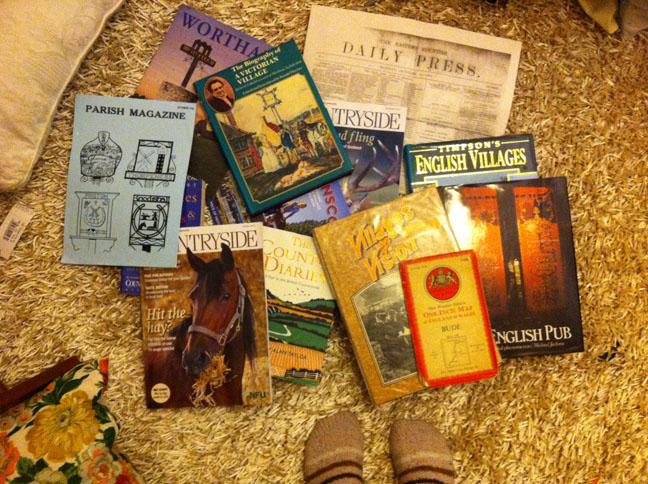
The reading is helping. Though every time I pick up a different book or magazine a million new avenues of exploration seem to open up and I find myself drowning in content.

My studio space is a hotch-potch of mini-projects I've been doing over this first half-term. These include:
- A briefing document
- A drawing source book
- A village tableau scene
- Several drawings of urban/rural fusion birdhouses
- A picture of a thatched flat-block
- Some laser-cut hand-illustrated sheep
- A Swallows and Amazons-esqe research trajectory map
There is a clear connection between all of these objects, but so far I have not quite pinned it down.

For this weeks' enterprise, I did a study of the iconography of English village signposts. I'm extremely interested in the imagery that communities use to identify themselves, and I'm sure I remember reading something by Viktor Papanek last year about the totems that Native American tribes used to rally around to enforce community bonds. (Note to self: look this up)
 It was really interesting to see what kind of icons recurred: churches, animals, pastoral/natural images, local landmarks, historical heroes, crests, dates and local industry symbols all featured highly as symbols of specific locations. This has made me give a lot of thought to the nature of collective identity: shared memory, traditions, experience. How is it represented and reinforced by tangible imagery? Does it really strengthen community bonds as it did for the tribal Indians in old America? What if the urban villages of London had a greater sense of collective identity?
 Could defining the identity of these areas in a similar way to small rural communities give the residents here a clearer sense of community?
Trip to Thorpeness- the Peter Pan village
I am seriously pissed off as I just spent a bloody hour writing, editing and formatting this pissing post only for it to disappear. NOT IMPRESSED WORDPRESS.[gallery columns="4"] As such, I really can't be bothered to re-type it all.
I wanted to get as much research done as possible while I was actually out in the countryside. So, on Wednesday me and my parents went on a jolly day outing to Thorpeness, the bizarre Victorian private fantasy holiday village. The only one of its kind in England.
It was bloody fascinating to go there- a kind of stage-set of a place. Weird ornamental architecture and more Peter-Pan references than you could shake a stick at.
But has it helped me further or expand my project..?
I'm a bit lost now to be honest.
(I'll post more about Thorpeness' history when I'm not so cross)
MINIATURE VILLAGE!
Last Wednesday I took myself off for a little jaunt around Bekonscot Miniature Village . It was flippin awesome.
[gallery columns="4"]
The place is huge, and no detail's been spared. This microcosm of the 'village world' captures the essence of rural British communities: choc full of the standard landmarks: churches, local businesses, farms, pubs, village greens. Every landscape sees tiny sculpted people going about their daily lives: There's a hunting party, cricket players on the green, kiddies around the maypole, morris dancers in the village square; church-goers, gypsy camps, drunk old men at the pub, old ladies hanging out the washing.... a neat little summary of the cliché of country life.
What gets me about these clichés... they're not just clichés. These are traditions, environments and scenarios which are deliberately practiced and reinforced by the country-folk. They bring greater value, and greater meaning to their way of life and the way they see themselves.
The miniature village is the perfect demonstration of the symbols and associations with which the typical countryside community communicates itself. So what do these symbols mean to people, what effect do they have, and could their associative qualities and effects be just as powerful if applied in the outside world?
Villages of Vision (and chocolate-box fraud)

Ok, so it's been a wee while since my last blogging enterprise. It seems I have fallen off the 'blog-horse'. Well, happily that doesn't mean I've not been doing anything...
Thanks to Gillian Darley that is. Villages of Vision has become the backbone of my research thus far. She talks about 'Picturesque' and 'Model' villages like I've never heard them described before.
During the early 19th Century, the wealthy middle-classes were becoming disenchanted with London's industrial cities. There was a rise in popularity of 'rural pursuits' such as hunting, rambling and making pretty watercolour paintings of the landscape (Gainsborough and the Dutch masters were to thank for this).
The leisure classes had decided to escape to the countryside, and the only way to do it was to become the smug owner of your own sprawling country estate, along with all the pomp and circumstance that this brought with it.

The countryside and the agricultural industries had been in a state of steady and inevitable decline for centuries. Many rural communities were poor, humble places where people struggled to farm a living- many of the houses in a state of collapse. Of course, for the new lords and ladies of the manors, it wasn't terribly pleasing to have a rag-tag settlement at the foot of one's grounds. The land-owners first began to 'prettify' these dilapidated buildings, and then eventually, to accompany their land with a brand-spanking new community: the chocolate-box English village.

And so the idea of the 'Picturesque' village was born. An image of rural utopia that still holds good to this day. To the city-dwellers, these villages represented an ideal, and land-owners had dreams of their own self-sufficient, semi-utopian communities that would showcase their wealth, taste and- incidentally- philanthropic enterprise.
Some key points of interest:
“The truly rural village retains an aura of attainable community, still representing a combination of rural escapism and human significance... an oasis into which the city people crawl thereby contributing to its disintegration.”
There were many series of 'pattern books' that offered guidelines and specifications for how to fulfil the picturesque cottage aesthetic. The detail in these guides was minute, from chimney designs right down to the types of creepers. The fashions detailed in these books became ever more outlandish, extravagant and eventually ludicrous; a mish-mash of architectural details adopted from a million different eras and countries.
The adoption of architectural styles of extreme irrelevancy is an escapist tendency. Good examples are Jacobean Railway stations and Mock gothic buildings of the Victorian era. All are evasions of reality, conformity and rationality which express the same reasons for the creation of fake villages and the recreation of rural life out of context.
The importance of these villages lies in the symbolism and associative qualities implied; the sense of community aligned closely with the settlement's aesthetics. "Picturesque villages are not just an anachronism. It's a logical response to and expression of certain needs; the wish for an environment which represents historical continuity, visual significance and emotional appeal."
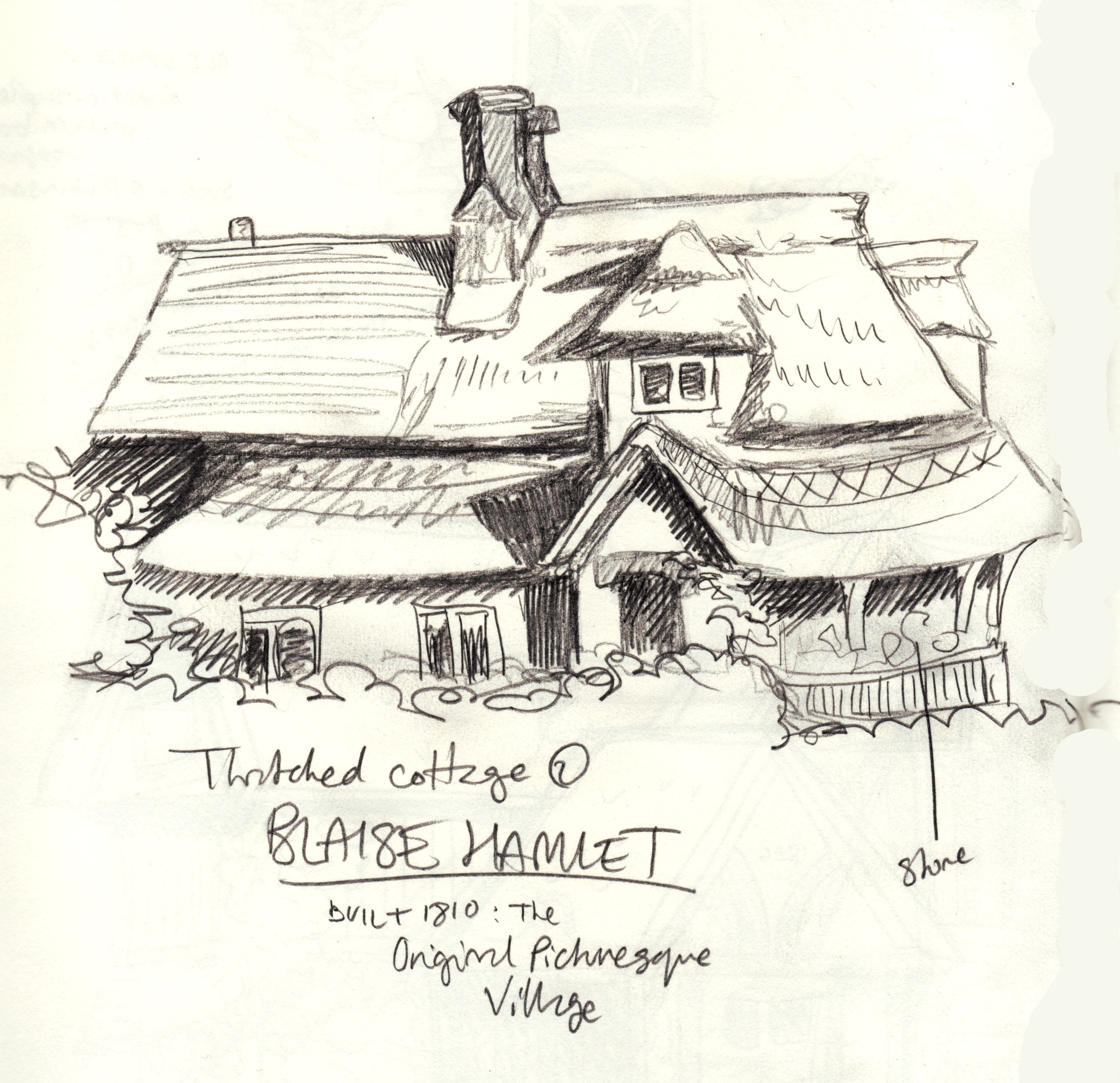
I have been exploring the idea that rural communities are perceived as the heart of some 'real' Britain, despite widespread urbanisation and the decline of countryside values. Now it seems that even the romantic vision of the chocolate-box English village with it's thatched-roofs and half-timbered frames is based on a fabrication. A fashion. A myth.
My oh my.
Research trajectory map design
I wanted to communicate the firm geographical routing of my subject as well as invoking the historical, traditional and sometimes mythical themes I plan to be touching on. Taking influence from historical and fantasty maps, as well as a hand-drawn footpath map I have of my home town, I fabricated a village landscape with pen and ink.


I did a little research into traditional olde English village and area crests. I really like the iconography intrinsic in these designs, and how instantly recognisable the style is. More research required- I'd like to be able to deconstruct these via symbol. Intrinsic storytelling. Hells yeah.

This is the final thing, hopefully it should help me maintain the focus of my research: Investigating communal identity in rural British villages.
Here are some other rather lovely maps...


Some pretty nifty research tings....
 Yesterday, not really knowing where to begin with my research and desperately needing to leave my house, I headed off to the Tate Britain. Although not completely useful it at least set me on the right track. I have worked out that I am more interested in the PERCEPTIONS that we have about the countryside, the way its inhabitants DEFINE and PROJECT their identity, and what forms this takes.
I read an interesting piece courtesy the Museum of English Rural Life which attempts to tell the story of the 20th Century countryside through artefacts. [Ref. Onkar Kular- whose exhibition I Cling to Virtue blew my mind at the V&A last week] Rather than going down the usual plough wheels and farm machinery route however, they've chosen to exhibit some icons of the countryside that have transcended rural into mainstream culture. Examples are: 
The barbour jacket, "something that began as required wear for your average hunt follower, is now to be found being sported by Lily Allen and the like."
 The Land Rover: "which first appeared in 1948 as a general purpose farming vehicle but which subsequently managed to mutate into a fashionable vehicle of choice for the metropolitan elite."

...and the Aga, "which emanated from Sweden and was brought to this country in the 1920s. By the 1950s it had become indelibly associated with the farmhouse kitchen and from thence it became not only a style icon but a potent class symbol of the second half of the twentieth century."
I liked this statement best: "If the right Landrover or the right Aga come along with the right story, we’ll collect them." ...so I'll be making the trip down to this collection in Reading quite soon I think.
As well as this, my flatmate studies media, and happened to have a book entitled British Culture, which contains an essay entitled Rurality and English Culture by Alun Howkins. Convenient eh? From this essay, I've drawn out several of his key observations about how the British relate to ideals of rural life:

- The perception that rural life is in decline has rallied communities around a 'stirring and practically based image of threatened belonging'.
- Images of pastoral beauty have been ingrained in our national sense of identity chiefly by war propaganda. Posters and official war songs including 'There'll Always be England' and 'Bluebirds over the white cliffs of Dover', and the deliberate icon of the war memorial on the village green were used to rally England under a collective National ideology.
- Rural Britain is at the heart of an idealised vision of 'real' England. The countryside has certain aesthetic specifications: Rolling hills interspersed with woodland, hedgerows lining fields. "even more importantly its ideal social structure is village with its green, pub and church clustered together. Ideal architecture stone or half-timbered topped with thatch."
- "Aesthetics, ruralistic impulse and urban decline created our image of the 'real' England: “...even before the first World War, this ideal landscape had ceased to be an exact geographical location and had become instead a set of features by which rural beauty was defined. The bringing together, before the Great War, of an elite view of urban and rural decline, a ruralist impulse, and an aesthetic of the southern created an ideal of the countryside which, all too often and too easily become 'real' England.”
So the set of criteria for which we base our vision of the countryside- the 'heart of true England' is fabricated upon a set of upper-class aesthetics and lifestyle ideologies. I like the idea that there is a formula of British Countryside.
If the image of the real Britain is false, then is a community's collective identity just imagined too?
Impostor Syndrome
 "impostor syndrome, sometimes called impostor phenomenon or fraud syndrome, is a psychological phenomenon in which people are unable to internalize their accomplishments."
This common psychological condition tends to affect high-achievers, academics and other individuals who most often could be considered in some way successful or accomplished. The victim of 'impostor syndrome' feels like a fraud, at risk of being discovered and exposed out at any time. Symptoms include:
- Dreading others' evaluations of your work or character
- Fear of not meeting others' expectations
- Attribute achievements to luck or mistake
- Rarely feel proud of a completed project or task
- Feel as though they should have accomplished more
- Fear of not being able to repeat a success
- Over-preparation, procrastination and making excuses
It is not an officially recognised psych. disorder, actually still a condition belonging to the 'pop psychology' bracket. Despite this, there have still been many extensive investigations made into its symptoms, causes and effects. Opinions differ, some believing it to be a cultural phenomenon:
"...people are left on their own, competition is intense, and there’s not much of a mentor system. They live in fear they won’t ever be good enough.”
I first read about the phenomenon a few months ago. It was in The Evening Standard or some other free paper I was reading on the bus on my way home. That particular article went on to say that the condition is gender indiscriminate, but has a tendency to strike far more women than men.
The explanation for this is that these thoughts, or the triggers for these thoughts are far more ingrained in the psychological make-up of a woman. Women tend to be far more critical and self-critical, because hundreds of years of human society has trained us to be that way. Traditionally, the woman who must secure a husband to have children, be accepted, survive. It would be the woman to leave her family and move in with her husband's, and had to keep everybody happy or risk being thrown out. This has resulted in a survival instinct to self-critique and check her behaviour constantly.
I'll confess to experiencing some of these thoughts and feelings. But how interesting the concept that anyone should fear being 'found out' of being themselves.
Surely design could do something to help or explore this? Interesting research anyways...
You can download a test to see if you're a sufferer here.
The Visual Essay

We live in an increasingly less literate society. By this I do not mean that we are becoming illiterate. But that we are reading less. Why is this? There are multiple factors: TV, fast-paced culture and a shift in prevalent cultural values have made us lazy. We have less disposable time, and so seek instant gratification. Entertainment and leisure overriding education and intellectualism as lifestyle qualities.
We inhabit a visual culture that constantly bombards us with striking imagery, containing layers of cognitive meaning and complexity that we are able to process almost instantly.
 As this Visual culture continues to gather momentum, the nature of more traditional communication media is being forced to evolve along with it. Magazines for example- with tabloid-style publications like 'Zoo' and 'Heat', we no longer have to 'read' a magazine; but rather we 'watch it'. Articles will feature an image, a headline, and a brief descriptive strap-line so that you can get the entire gist of the feature without reading more than three sentences. Information is structured in clear, easy-to-follow formulas like bulleted lists, and typography is designed to keep your eyes constantly stimulated.
It is probably no coincidence then that the popularity of graphic novels has grown tremendously over the course of the last decade. According to industry observer ICv2, sales of graphic novels in the US and Canada has grown from $75 million in 2001, to $375 million in 2007.

So everybody likes superheroes, right? Wrong. Comic books are rising to their new-found position as a valid literary form- the birth of the Graphic Novel. Now that medium too is evolving. In Web 2.0, the popularity of the web comic is growing, and the possibilities for the graphic novel as both an artistic and literary format in its own right are just being discovered...
Is there something in information structured by imagery that makes it clearer, or easier to understand? Or is it just a case of attractive visual stimulation and laziness of the everyday user?
Either way... I do kind of love it. And I say that as an ardent reader.

References:
- Rick Poynor- Obey the Giant
- Scott McCloud's books and Ted Talk.
- A large collection of comic books.
Wells Blog
Duis mollis, est non commodo luctus, nisi erat porttitor ligula, eget lacinia odio sem nec elit. Maecenas faucibus mollis interdum. Nulla vitae elit libero, a pharetra augue.


Commodo cursus magna, vel scelerisque nisl consectetur et. Donec id elit non mi porta gravida at eget metus.