
Back on the blog-horse.
It's been a long two weeks, and despite my blog neglection it has been pretty busy too. It's been particularly interesting on the contextual front, and a wealth of new and very clever stuff has implanted itself in my brain courtesy of people like Benedict Anderson and Arjun Appadurai. On top of this, some very clever and inspiring artists like Karen Guthrie and Nina Pope, Tom Hunter and James McKinnon, as well as Goldsmiths' very own Pete Rodgers have given me more than my fair portion's food for thought. But, if I go on like this the word count of this blog post will be longer than my dissertation.
So what follows is a very brief summary of how my project has changed and evolved over the last two weeks or so. I really hope it makes sense...
Last week I wrote a bit about Urban myth and legend, having been interested in Nessie and the Black Shuck of Norfolk/Suffolk. I came to wondering about how a character comes to exist on a level of communal consciousness, and how a locality's desire to make tangible some recognition of its existance- within their minds- results in a system of half-belief: we know it's not real yet we like to treat it as though it could be. In other words, we'd like to remember it that way. In Bungay, the local running club is named after a hell-hound.
"The long-term reproduction of a neighbourhood that is simultaneously practiced, valued and taken-for-granted depends on the seamless interaction of localised spaces and times with local subjects possessed of the knowledge to reproduce locality." (Appadurai, 1996)
From here, I've become extremely interested in collective memory, knowledge and remembering. I've already discovered a lot of evidence that suggests that familiarity within our environments (knowing the history, people, stories and physical spaces) precipitates contentedness and community. It is almost certainly this that makes the tight-knit rural communities of England seem so ideal. They visualise and mark their history, they tell stories and talk about local heroes and gossip. Adapting Marx: "local knowledge is not only in itself, but of itself."
So I've been investigating communal knowledge, memory (Benedict Anderson has some wonderful things to say on the subject of Imagined Communities) and nostalgia. Why and how we preserve and value the past, and ways in which we live our history alongside our present.

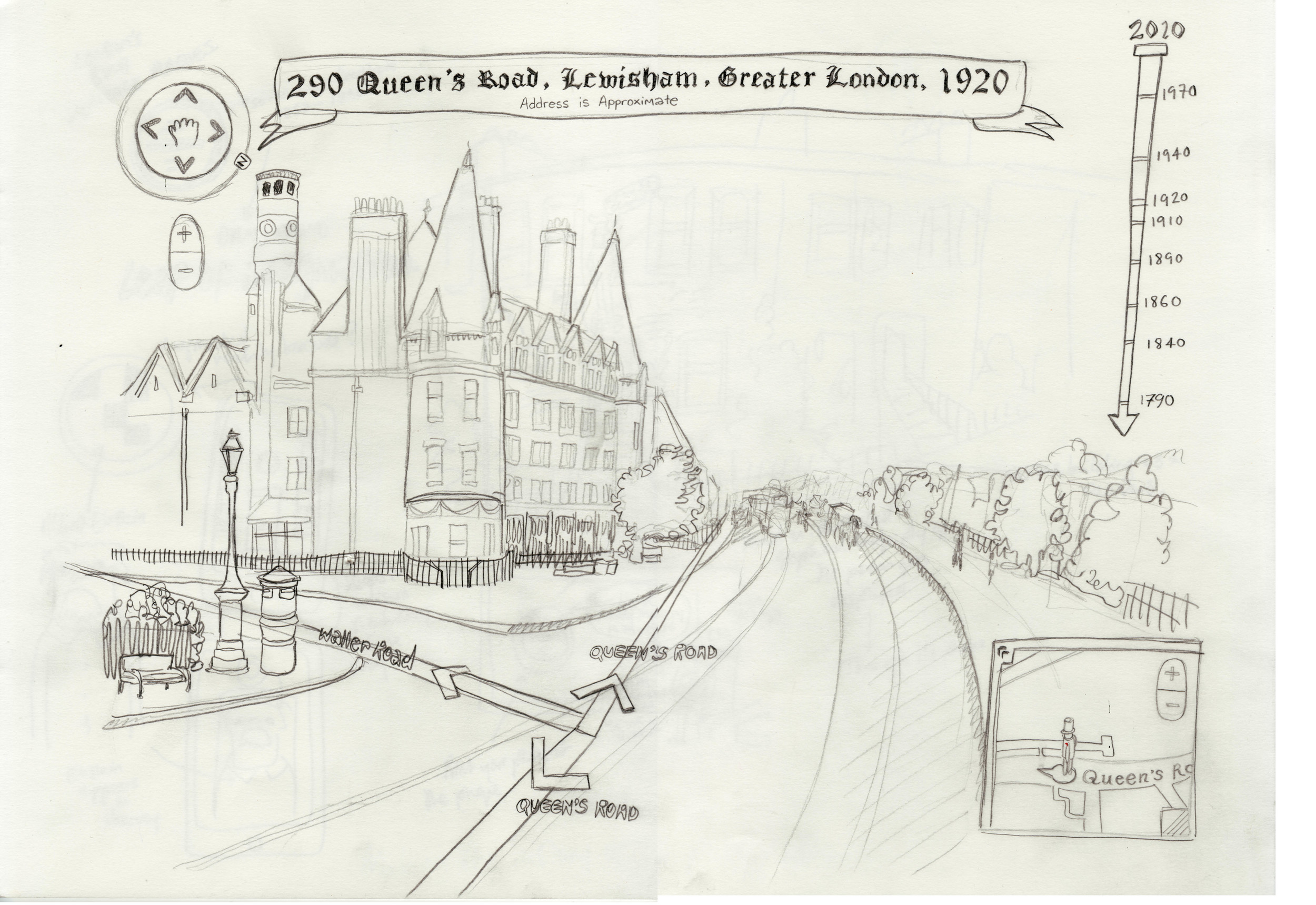
Aaghh, if I hadn't left this post so long I would detail my visits to Dennis Sevvers' house and Museum of London as well as my interview with a Medieval reenactor, but it will take forever...
Thinking about ways in which we memorialise things, I read a lovely quote by the lovely Stephen Fry: "We all pay lip service to the idea that yesterday makes today, but it is difficult to make the imaginative leap that truly connects us to our past... Blue Plaques, in their simple way, address this defect... for me, they are a unique imaginative portal into the past, for in my mind all Blue Plaques are contemporaneous, which is to say, the people commemorated by them are in their buildings now."
I love the blue plaque scheme too, but equally am always left faintly under-satisfied whenever I don't know who someone is, or their situation while they lived there. What if we could make their history more real, more visible?


After my visit to the Museum of London, seeing their London's Voices projects and also discovering the work of somewhere.org and Tom Hunter and James McKinnon's The Ghetto, I've become more interested in the idea of subjective histories or stories becoming part of a general community memory or consciousness. In Robbie (the medieval reenactor)'s words: The battle takes shape through a "multiplicity of subjective curators". And in the same way, a picture of a history (accurate or not) is painted on a woven tapestry of personal reminiscence. I LOVE this.

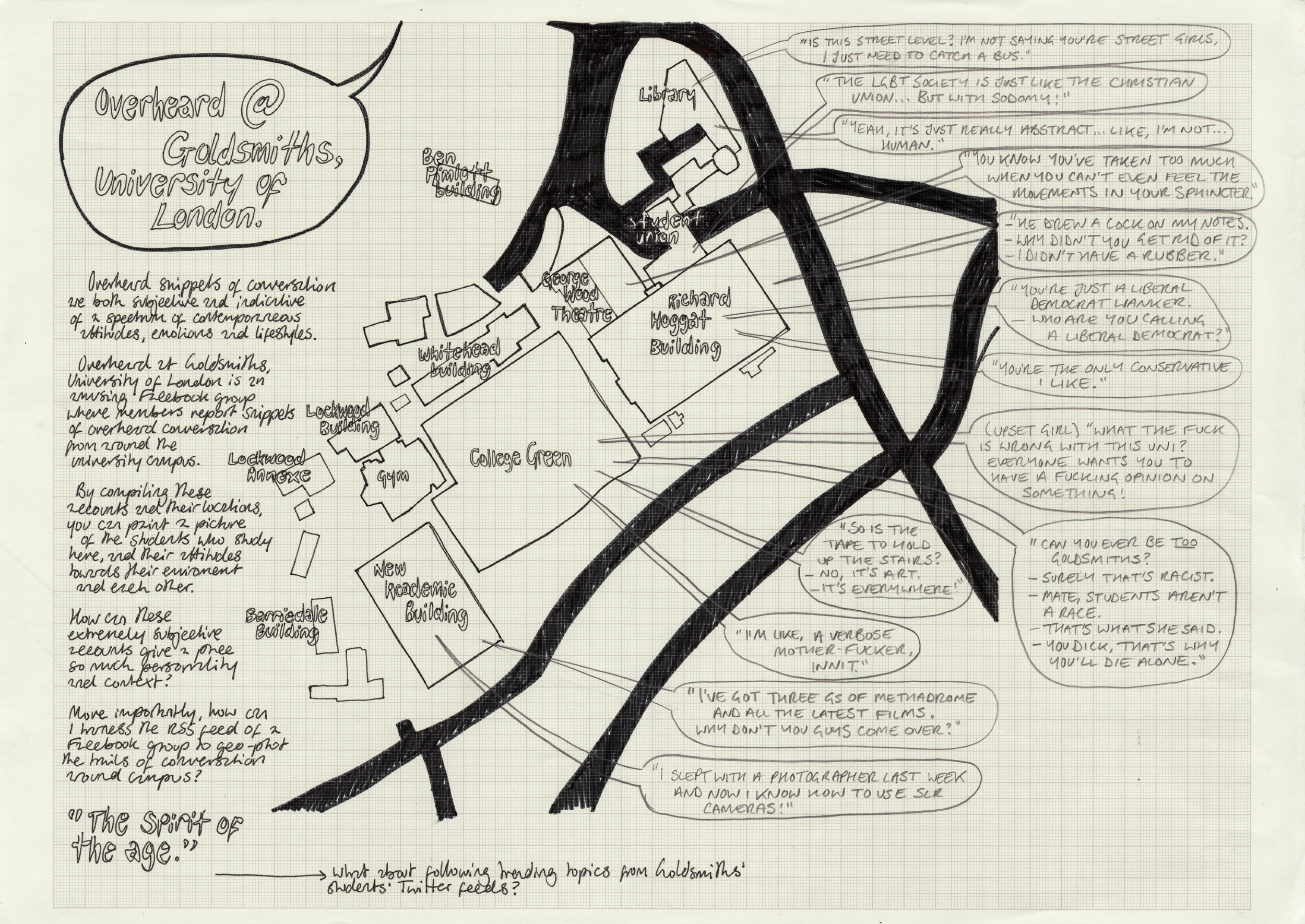
All of these thoughts and ideas are very much in their emryonic stages at this point, but I'm feeling pretty good about this.
My mantra has become 'Stories are inclusive'. Now I just need to find some stories!
Future Nostalgia?
I've found a DIAMOND book in the library, The Countryside Ideal by Michael Bunce. It's basically about the idealisation of rural life in Anglo-American culture. ie: why we idealise the countryside, how we idealise it and the projections and assumptions that we make about life there. It discusses how attitudes toward the countryside are as a result of urbanism and industrialisation. If the population of Britain's countryside continues to grow at such an alarming rate (3x the rate of urban environments) and if we continue to aspire to a 'simple, quiet' life in the country, it's not going to be too long until what remains of the rural idyll captured in the national mind's eye is nothing but a story. A myth left over to tell the grandchildren about. It's already happening.
I watched this the other day. It featured a village whose history spanned a thousand years, and in the 1930s featured in a movie showcasing it as a rural utopia- the perfect escape for the middle classes. Years on, the programme takes a look at the same village, talking to a farmer whose old cow-shed is now a £700,000 barn conversion and a city-worker whose two-hour commute home at night crosses paths with a local builder who can trace his family back through the village six generations as he returns to town- no longer able to afford to live the picturesque ideal that is his heritage.

I know I've already rambled about the genius of Will Self's The Book of Dave a few times, but I dragged it out yet again to have a look through the maps in the front. Visions of London underwater at an indeterminable point in the future. It's full of social and cultural references to the present day. Misremembered and misinterpreted scraps of information and tradition that live on in a broken, fragmented kind of way amidst the new, future culture of Ing (England).
Why do we reflect on lost times and ways of life and elevate them as ideals? Why will yesterday always seem better than today? Countless historical sites stage historic reenactments. Kentwell Hall in Suffolk is the first that springs to mind. During the summer months, they employ around 70 full-time Tudors who work the land and run the house as they did in the 1500s. Tales of a lost time, when things were simple, folks worked hard and were happy, and wore silly costumes and spoke silly words.
I remember visiting Kentwell Hall on a school trip when I was really small. Completely overwhelmed with the place, my childhood imagination reveled in the idea that I had actually been transported back in time; that these people were actual Tudors. It was wonderful... until I spotted the strip lighting on the ceiling inside one of the cattle sheds. The boards covering it over had not been replaced properly, and the illusion of my escape into another time was shattered.
In as little as thirty years time, it's likely what remains of the culture and traditions of the Countryside will have been warped beyond all recognition. After all, its the people that these qualities live through- not a tangible landscape or object. So, in our future attempts to uncover the lost vision of Britain's countryside what assumptions will we make about it? Will the children of 2050 sit through an granny-style afternoon tea or a Harvest Festival with the same detatched sense of awe that I felt about the ladies churning the butter in Kentwell gardens? Will it be the same? And what form will our idealised communities now take? We're already stumbling into a future where idealised rural-living is artificial, misplaced and misinterpreted (like this), so what will they look like by then?
God of all things good, Russell Davies had a great idea with his Lyddle End project, where he took the charming railway models of fictional picturesque Lyddle End village and asked artists and designers to remodel them as they'll look in 2050. I love this idea that the chinese-whisper effect of history will contort the recognised into something alien. Also, read this. Oh, isn't he so very clever?

So, more stuff to look into. I want to find out more about these funny folks who dress up and relive history in a variety of weird and wonderful ways, and just why they do it. The escapist element is obvious, as is the nostalgic one. But I'm mostly interested in the inaccuracies of what they do. The fuck-ups and faux-pas of the reenactments. Is it the accuracy that matters to them? Or just the illusion that they have- just for a short time- the undesirables of living life today.
If anyone reads this (in my optomism that anyone makes it this far through my rambling) and has any suggestions for reenactment events or venues, or better- knows anyone who likes to get dressed up and have sword-fights I'd love to hear from them. The closest I've come to experiencing this was my 18-month flirt with WOW. And I don't think that quite counts...
Uh-oh: tangent
Uh oh...
I'm having what you might call a 'hiccup'. It's been an odd week. I crashed my car which wrote Tuesday off (amongst other things), and Wednesday I gave my Territories presentation. Possibly the worst presentation of my life I might add- I hadn't practiced and the allotted five minutes ran into fifteen. Shit. Now I have a cold. And all I seem capable of doing is sitting in bed thinking myself into holes.
This is going to be another one of those trail-of-thought honesty rants. Advance apologies.
The feedback from my (dire) presentation made me realise a few things: a) Urban chintz and decoration has been done to death. And better than I could ever do it, by him, him and these guys. b) Villages already exist in London (well, I already knew this but have been resisting it) so what point am I trying to make by blending these aesthetics? c) I'm looking too big, I need to design for something/someone specific. d) I need to establish a user.
and aside from all of this,
I STILL CAN'T GET FLIPPING MAPS OUT OF MY HEAD.
What is it exactly I'm trying to achieve here? What am I originally interested in about villages?
- Engagement with your environment and how it shapes your identity, and the ties we form with the physical landscape.
- British identity and nostalgia- why is it so wrapped up in the image of the countryside?
- Collective memory- stories and events exclusive to a community that help make it unique.
The other day I found this:

It's a map of Deptford and New Cross from 1840. As it turns out, most of it was still fields back then. A village overspill of London, if you like. It made me realise- on a deeper level- the history and human-ness that is all around and yet completely invisible to me. I realised also, that any sense of belonging to a place comes from familiarity, and the memories that bind themselves to the physicality of the world around you.
I have already discovered that happiness and contentment within your environment comes from familiarity, and the nostalgia of lost memories. I conducted a small survey (and by small, I mean 20 people or so) a couple of weeks ago, and the results showed that a person will almost always remember being happier in the place they grew up- the place where all the relationships are already formed. Reminiscent nostalgia.
Some other research I've found particularly interesting is the overwhelming tendency for the elderly to retire to the countryside. The inherent nostalgia of the place beckons even those that have never set foot outside a city before. And according to the reading I've been doing on various retirement forums, a lot of the time the new environment- away from familiar sights and relationships, friends and families- can result in some unhappy twilight years.
So. With all this in mind, I've been thinking there could be a lot of potential in talking to London's elderly population. Why are so many inclined to leave? What are the perks or problems of being retired in the city? What has changed? All of these could open fantastic potential avenues for design, but essentially, I just want to hear their stories. If community life is entangled in memory, then can't I somehow borrow somebody else's? What if I could make these stories and memories tangible?
So then I started thinking- how can you make a memory physical?

Here is a map of my childhood memories. Not the memories themselves per cé, but the locations I find them enveloped in. It in no way represents geographical accuracy, but it means familiarity: locations functioning as thought-anchors for my reminiscences. I find this concept of psycho-geography fascinating.
What if I could make maps of nostalgia. Telling tales about London from the people who've grown old here. Could this somehow work to transfer reminiscent affection from its origin to a new user, to help nurture a sense of familiarity, and thus community and contentment?
My head hurts. And this is a big tangent. Is this wrong? I don't know... but I'm still retaining my core themes: Environment and familiarity, nostalgia and romance. It's just not quite Villages any more is it?
Urban Chintz
So I've been thinking a lot about countryside artefacts, and thinking more about how it is that we've come to have images of pastoral landscapes and chocolate-box cottages engraved onto what remains of our national id.
I've also been thinking about what Oscar Wilde said about wallpaper (see this post from week one). And then looking at some of William Morris' designs for it. I recently happened upon the Guardian's Homes supplement part of the paper left on a bus seat which contained series of articles in which city homes and interiors sought to recreate the qualities on country living. It's interesting to me that we use these props as ways of borrowing what is essentially the facade of a particular lifestyle and displace it deliberately and obviously- all through a few bits of china.

We tie most of our associations of idealised country life into rural and natural imagery, and this is most often displayed on objects which are closely aligned with traditional social rituals and environments. Like tea-sets, for example.
As the population of rural England continues to grow, perhaps this traditional imagery can be subverted to represent a more realistic image of Britain: the urban landscape rather than the'cultural fiction' of the pastoral. By emulating the rose-tinted styling of china, wallpaper and chintz but with symbols of the city instead of the country, can I nurture a more idealised and romanticised view of urban Britain and help promote a more attainable way of life?


And then I got a little carried away and made a bit more...


I must admit, I really like the idea of turning the most florally-repugnant objects of the most elderly-relative variety into bad-ass 'urban chintz'. Potentially very amusing.
Consolidating rant...
What follows is the first draft copy+paste of what I had intended to be a simple outline of my project. What it actually is is a load of meandering thought-trails, lists, non-sensical grammar and some probably quite rubbish ideas. But who cares? This is where I'm at right now:

------------------------------------
So I've been a bit stuck this week.
I've managed to produce a few bits and pieces, but the 'flow' has all but left me. I'm sure that this is more a reflection on me than on my subject matter.
Last night I sat down and tried to form some cohesion of my interests and themes that have manifested themselves in my little endeavours so far. I don't think that I'm analysing my motives hard enough.
The most important themes present in my work so far have been:
- -Nostalgia
- -Village Environment Aesthetics
- -Symbolism
- -Naivity/ Childishness
and my key points of research have been:
- -Projection and manifestation of Stereotypes (miniature villages etc)
- -Model and utopian Villages (Thorpeness)
- -Happiness and environment
- -Community identity
- -Personal Geographies and escapism
------------------------------------
My most recent and more specific statistical findings include:
- -People who have lived in the same place for more than 5 years are more likely to be happier. Thus, familiarity = happiness. (not just because you live in a village) (Source: The Happiness Formula, BBC 2008)
GFKNOP.com Consumer Trends: Nostalgia Report:
Recession provoking nostalgia: 62% consumers experienced a negative monetary experience in past year, 23% positive one. When things are crap in the now, we escape by looking forward to when times will be better, or by looking back to when times were better. Because nobody knows what the future holds, it is easier to look back. Evidence:
- Resurgence of nostalgic brands: Arctic Rolls, Wispa bars (hurrah!), Birds Custard
- Revival of bands and musical styles: Take That, 80s Synth: The Killers La Roux
- Movies and TV: Dr Who, Life on Mars, A-Team etc.
- 'Retro Styling, Modern Function': Beatle, Mini, Fiat
- Emphasis on heritage (trustworthiness): Persil "Tough but gentle for 100 years"; Hovis "As good today as it's ever been"; M&S "125 years since the penny bazaar"
*NOSTALGIA 2.0: Like the first time, but better!
(Reviving nostalgic images of Britain and evolving them for the modern one)
'Rusource', Commission for Rural Communities
- -The rural population of Britain is growing at a much faster rate than the urban due to in-migration. Perticularly in ages 0-9, 30-44 and 60+ age ranges. People still want to raise their kids and retire in the country.
- -The 15-29 age ranges are leaving rurality for urban environments at a much faster rate too, mostly through higher education.
- -The average age of the rural citizen is 5 years older than that of the city.
- -Current government development schemes discourage development in rural areas with emphasis on urban and town fringe areas.
State of the Countryside Summary Report 2010
- -23.5% of people in rural areas are over state retirement age, compared with 18.1% in the city. The South-West and East-Anglia have the highest 60+ populations in the country, at 121,900 and 92,600 respectively.
- -You are more likely to have a greater sense of well-being in your environment if you live in a rural community. 87% in rural compared with 76% in urban.
- -It is significantly more costly to live in a rural environment than in an urban one.
- -Greenhouse gas emissions are higher in rural areas for all sectors. Significantly more by transport because of greater distances travelled.
------------------------------------

This presents me with a few obvious points and dilemmas to focus on:
The population in rural areas is growing due to pensioners and families inmigrating from cities.
- -small, familiar communities are saturated with strangers, diluting community bonds and trust.
- -There aren't enough public services or housing to support this influx
- -Growth of non-independent and corporate commercial development in response to demand for more efficient amenities. Undermining independent business.
- -Age segregation: the older in villages, the younger in cities. Loss of integrated communities.
So basically, the problem is this: people would rather grow old or raise a family in the countryside, and this is messing quite a few things up. What i need to determine is:
- -WHY people want to in-migrate to rural areas.
- -WHAT are the benefits and qualities of the village environment.
- -HOW these perceived qualities are manifest; how they are visualised, enacted and reinforced.
I need to look at the perception of the chocolate-box Britain and its advantages, then somehow project this onto urban environments in order to tempt people to raise families and grow old there:
- -Prevent over-development in rural areas
- -Attract rural levels of contentment to urban areas
- -Promote a more evenly balanced mean age of population in both.
So... modelling week didn't quite happen...
It's been a weird week in which I have generally been procrastinating and desperately trying to avoid my project. Although I'm not quite sure why.
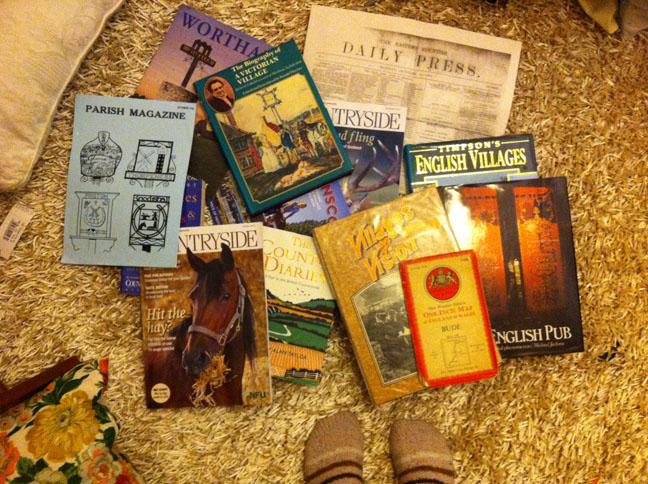
The reading is helping. Though every time I pick up a different book or magazine a million new avenues of exploration seem to open up and I find myself drowning in content.

My studio space is a hotch-potch of mini-projects I've been doing over this first half-term. These include:
- A briefing document
- A drawing source book
- A village tableau scene
- Several drawings of urban/rural fusion birdhouses
- A picture of a thatched flat-block
- Some laser-cut hand-illustrated sheep
- A Swallows and Amazons-esqe research trajectory map
There is a clear connection between all of these objects, but so far I have not quite pinned it down.

For this weeks' enterprise, I did a study of the iconography of English village signposts. I'm extremely interested in the imagery that communities use to identify themselves, and I'm sure I remember reading something by Viktor Papanek last year about the totems that Native American tribes used to rally around to enforce community bonds. (Note to self: look this up)
 It was really interesting to see what kind of icons recurred: churches, animals, pastoral/natural images, local landmarks, historical heroes, crests, dates and local industry symbols all featured highly as symbols of specific locations. This has made me give a lot of thought to the nature of collective identity: shared memory, traditions, experience. How is it represented and reinforced by tangible imagery? Does it really strengthen community bonds as it did for the tribal Indians in old America? What if the urban villages of London had a greater sense of collective identity?
 Could defining the identity of these areas in a similar way to small rural communities give the residents here a clearer sense of community?

Arts and Crafts day...
Seeing as it's image week and I'm doing a project about villages, I thought it might be sensible to actually go to one. So here I am, back on the sunny Norfolk/Suffolk divide in the heart of lovely rural East Anglia. Smell that Autumn air. And complain about the weather, because it's absolutely pissing it down. Not quite sure where to start, I went on an inspiration mission looking for images that might effectively 'capture the essence' of what the Villages project is all about. Seeing as I myself am not yet sure about this, I thought this could be a little bit of a struggle. Out on my little drive, one thought immediately struck me: the countryside ain't always quite as pretty as you expect...
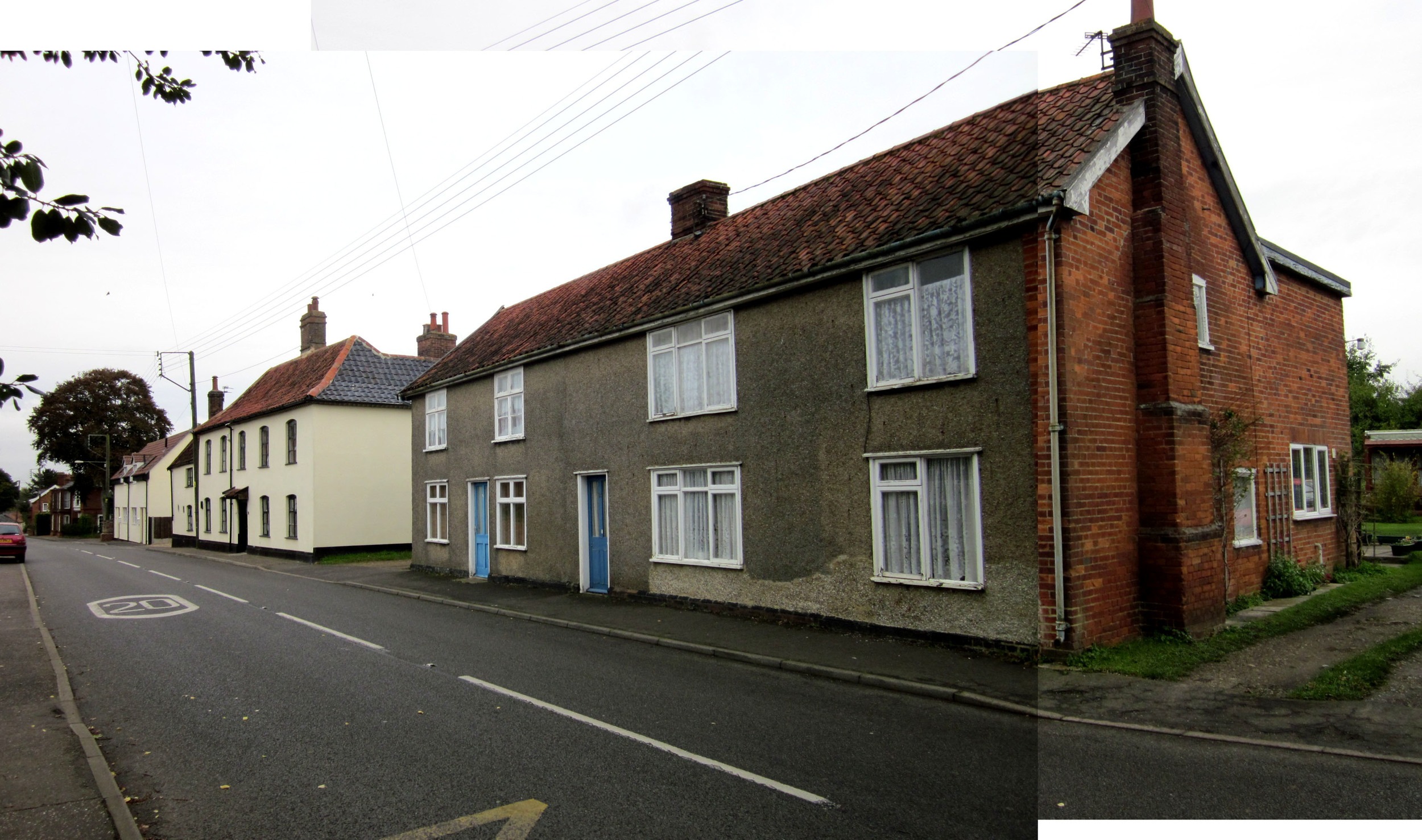
But in general, the area does still come wrapped up in a chocolate-box bow. All over the place there are still signs for village fêtes and farm-shops, and the local paper shop is rammed with historical books about the area. These countryside folk really are happy to be so. I forget this sometimes now that I'm down in London nearly all year. The ideal of country living is alive and kicking. So, even if it's not always as pretty as we think it should be, the ethos lives on regardless.
My project has been very wrapped up in aesthetics so far. The images we rally around, the ones we hide behind, the ones we project in order to represent how truly lovely it is to be in the countryside. There's a simple and charming naïvity to it. And this was what I decided to try and capture.
I went on a little road-trip collecting photos with my shitty compact camera in the dismal weather, and successfully came back with a whole heap of examples of buildings found in typical rural idyll...


But the light was crap, and it got wetter and colder until I couldn't even be arsed getting out of the car. Feeling like a bit of a child I ventured to the local toy shop and bought a load of PVA, coloured card and crêpe paper, before buggering off home to a cup of tea, my mummy and some quality rainy-day activities...
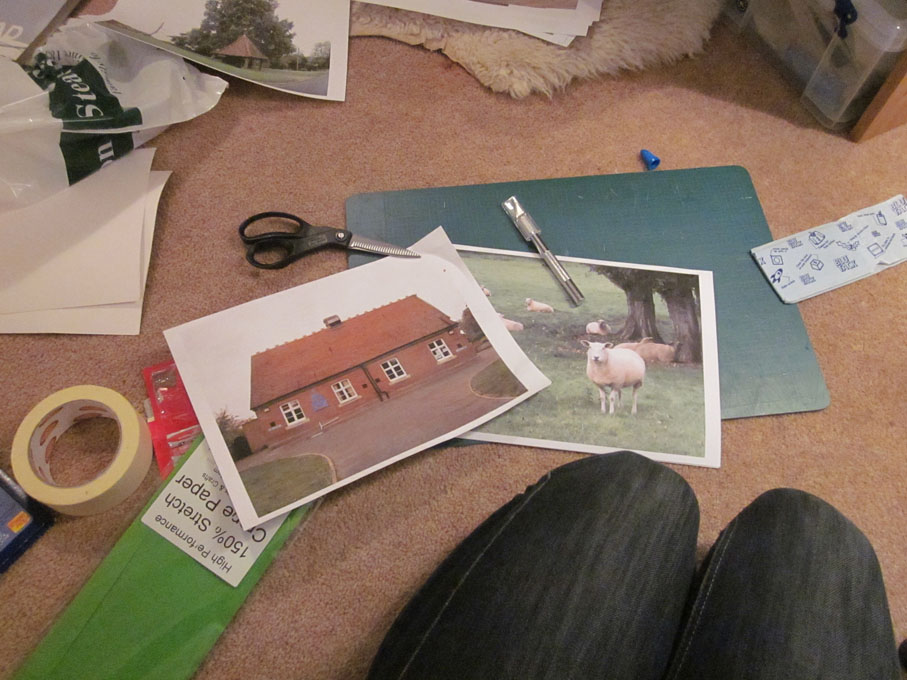


I had the idea of like a nativity tableau... you know how they look like a proper three-dimensional scene but as soon as you move a bit you realise they're just flimsy bits of card and straw? The thought is sincere,but it's also a little naïve and idealistic- a bit of a fantasy, really. And their's no denying that although the final product may look pretty enough from the right angle, ultimately, it's only gonna fall over or get trodden on...

I had a lot of trouble getting a good shot. Lighting was hilarious. I think I must have had every single lamp in the house gathered around my desk. I've been using my Canon compact for everything, and as my parents are also techno-phobes their was no SLR or DSLR to be found. Sadly I have had to make do with my final photograph...

Yes, I am a child. A bad-at-photography child. But I had a very fun day.
(PS. Chris, does this constitute 'messy play'?)
And so, Villages it is...
What a coincidence. Just last week I was thinking about villages: identity and stereotypes. We're assigned to open the paper and draw out an issue from any article we liked, and guess what?

So, I guess that's fate deciding that villages it is! So yesterday was spent trying to figure out exactly what it was about villages I was really interested in. And I settled on...
How do Rural Communities form an identity for themselves?
The article above featured brief stories about villages throughout the UK- their idicoyncracies, their bizarre customs and rituals, their historic signifigance...

I love the idea that communities come together under shared rituals. And in this case, the symbol of the Hare Pie is a rallying symbol for the whole village. When it was threatened one year by the village Pastor (because of its rumoured Pagan origins) the slogan 'No Pie, No Pastor' was found dawbed acr0ss the church walls the next day. A worthless pie, priceless in symbolic value.
My research routes will be:
- Weird Village Traditions
- Pastoral Iconography and Identity
- British rural perceptions and projections
Material Definitions
[gallery columns="4"] Over my lifetime I have accumulated a lot of crap. Ragged cuddly toys I've owned since the beginning of time mold contently at the back of my cupboards; boxes overflowing with scraps of paper-tickets, doodles, letters, certificates gather dust on top of shelves; nick-nacks, torn-up books, photographs I'll never put in frames and bits that have fallen off other bits that I won't throw away just in case they come in useful again adorn every available surface.
I love clutter. I immerse myself in these bits of junk that mean nothing and everything. I collect antique cameras that I never uses, broken watches I'll never repair, and stacks upon stacks of books that I'll probably never read. Why?
I am fascinated by the qualities we project onto our possessions. I'm sure this sounds familiar. Marxist theories of Commodity fetishism have been boggling my mind for a while now, and my interest in human relationships with their material environment has been ongoing since I can remember.
They say that the whole is greater than the sum of its parts, and I believe this statement applies to personal expression through possession perfectly. That is to say, a single book; a single pen, a lamp or chair would not go far in defining a person's character as a whole. However, when put together, a selection of miscellaneous objects can weave a portrait with their symbolism, their attributed qualities, the roots of their implications.

How do we read a person's possessions? How do we draw conclusions about intangible assets through readings of tangible ones? How do we select what we consume by way of expressing the way we see ourselves, and how accurately do our possessions reflect the truth about us? Are we influenced in our opinions of others through what they own? How can we use objects to construct a narrative around an individual?
Impostor Syndrome
 "impostor syndrome, sometimes called impostor phenomenon or fraud syndrome, is a psychological phenomenon in which people are unable to internalize their accomplishments."
This common psychological condition tends to affect high-achievers, academics and other individuals who most often could be considered in some way successful or accomplished. The victim of 'impostor syndrome' feels like a fraud, at risk of being discovered and exposed out at any time. Symptoms include:
- Dreading others' evaluations of your work or character
- Fear of not meeting others' expectations
- Attribute achievements to luck or mistake
- Rarely feel proud of a completed project or task
- Feel as though they should have accomplished more
- Fear of not being able to repeat a success
- Over-preparation, procrastination and making excuses
It is not an officially recognised psych. disorder, actually still a condition belonging to the 'pop psychology' bracket. Despite this, there have still been many extensive investigations made into its symptoms, causes and effects. Opinions differ, some believing it to be a cultural phenomenon:
"...people are left on their own, competition is intense, and there’s not much of a mentor system. They live in fear they won’t ever be good enough.”
I first read about the phenomenon a few months ago. It was in The Evening Standard or some other free paper I was reading on the bus on my way home. That particular article went on to say that the condition is gender indiscriminate, but has a tendency to strike far more women than men.
The explanation for this is that these thoughts, or the triggers for these thoughts are far more ingrained in the psychological make-up of a woman. Women tend to be far more critical and self-critical, because hundreds of years of human society has trained us to be that way. Traditionally, the woman who must secure a husband to have children, be accepted, survive. It would be the woman to leave her family and move in with her husband's, and had to keep everybody happy or risk being thrown out. This has resulted in a survival instinct to self-critique and check her behaviour constantly.
I'll confess to experiencing some of these thoughts and feelings. But how interesting the concept that anyone should fear being 'found out' of being themselves.
Surely design could do something to help or explore this? Interesting research anyways...
You can download a test to see if you're a sufferer here.
Small Town Syndrome
I'm from Norfolk. When people find this out they generally ask me [in a thick and ill-conceived West Country accent] do I live on a 'faaaaaarm', is my brother is my cousin and whether I have webbed toes.

Home is a small town on the Norfolk/Suffolk border called Diss. It has a population of around 7,000. Everybody knows everybody else. We use phrases like "that's on the 'huh" [it's a bit wonky] and describe things as "a rum do" [what a strange occurence]. Most people get married young and have babies. And yes, most people have a lot of cousins.

It is easy to make generalisations about a place, but as they say- there's no smoke without fire.
- Why are Northerners friendly and Southerners miserable?
- What changes a dialect, an accent- where do slang words originate and evolve?
- Why does a lifestyle differ from place to place?
- How did we come to forge these stereotypes?
OK, OK... so the socio-cultural, political, economical and environmental factors are obvious and hugely variable. That's not a project; that's common-sense.
What I'm interested in rather, is how behaviour begets behaviour in a small-town environment, and to focus on the material and tangible repercussions of collective social phenomena.

I want to investigate what causes localised mindsets and values, how our social networks (the figurative ones, not the digital ones I mean) cause us to think and act in certain ways;
- What are the effects of growing, living, interacting within a small, familiar community?
- How does that change the behaviour of an individual, or of a group, or even a whole neighbourhood?
- Why do we form perceptions of regions, and how do the ripple effects of close social networks manifest themselves?
- How does our environment effect us as individuals, and how does this in turn reflect on our environment?
- Would it be possible to use these patterns as a template to make predictions about a person's future?
Nicholas Christakis believes that traits are contageous. That we can 'catch' happiness and spread behavioural patterns such as over-eating or drug abuse through complex and enormous social networks. His theory is that these networks we exist within significantly affect our lives.
THIS SOUNDS FLIPPIN INTERESTING DOESN'T IT?
Why Do Rational People Hate to Tempt Fate?
Superstition is embedded in us. I recently read this article at Spring.org.uk "We absorb superstitions from around us, especially vigilant for their occurrence and reinforced by any events that fit the pattern, conveniently forgetting events that don't fit."

Logical people do not want to wear a murderer's jumper (Sean Hall- find notes)
When we're kids we can believe that our toys might come alive at night, that Father Christmas comes down the chimney or that there's a monster under the bed. It is only after we accumulate experience that our sense of 'magic' is dispelled and we begin to lose our naivity and willingness to believe in phenomena.
Aside from things like religion, paranoid UFO enthusiasts and superstitious old ladies (let's call these cases to compare against) we mostly live in an age and culture of cynicism and disbelief.
What interests me about the above article, is that it suggests that rather than being merely naivity or a willingness to believe in irrational phenomena it is something that is imbedded in us- part of our psychological make-up. If this is true I'd like to know why, how this might have manifested itself throughout time, and how I might be able to exploit this fact to recapture the imagination of even the most disenchanted critic.
I want to research and investigate ways in which superstition, mythology and fantasy form an integral part of the tapestry of our lives. Folklore and stories affecting behaviour- social ritual and ceremony.
How can I weave a bit of magic back into life?

- Immersive environments,
- experiential design,
- artefacts.
- Ways in which superstitions are already exploited.
- Psychological causes and effects of superstition
The Catastrophic Effect of Ugly Wallpaper
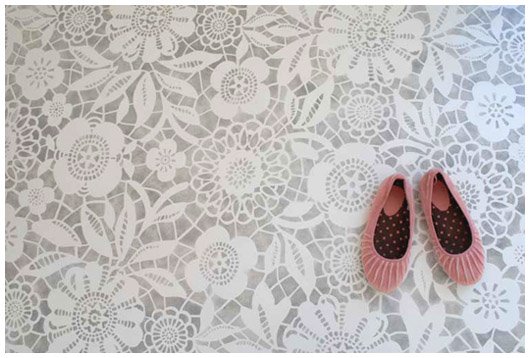
As designers, we are taught that beauty for beauty's sake is useless, and that purely decorative or ornamental artefacts are frivolous and valueless.
Oscar Wilde was one of the leaders of the late 19th Century aesthetic movement. Whilst touring the USA during the civil war, was asked why he thought America had descended into violence. His answer was simple: "because you have such ugly wallpaper".
The argument runs that human beings have done our best to despoil the greatest beauty available - nature. Compounding that is the fact that so many of us choose to live in 'ugliness' created by ourselves, so what must that do for our sense of self worth and how we value others? And finally, living in ugliness, and devaluing ourselves and those around can only, eventually lead to violence...
I like this line of thought particularly because it makes explicit the fact that we do value our surroundings, the things we own and use, and the relationships between all these things. We spend our lives building an identity - for the outside world, and for our internal world. And we do this through the stories we tell about ourselves, and also through the objects we collect around ourselves. Through an implicit and explicit selection process we build a visual version of ourselves that we trust to help tell our stories ...

I love to make things beautiful. I can't help it. I love twiddly, pointless detail. Irrelevant imagery that adds some intricacy, some added-interest, and some character to the banal and irrelevant materialism that we use to define ourselves.
I would not describe myself as a materialistic person, yet I surround myself with objects that I feel are beautiful and improve my mood and my perception of myself. My room is a mess of art books, antique cameras and wristwatches, and my walls are consistently adorned with an ever-changing rotation of beautiful imagery that strengthen my personal identity and help me communicate my traits, values and interests to others.
Why this compulsive fetishisation of material goods? Goods that are not even representative of wealth or allude to a successful or luxurious lifestyle?

My question is: can surrounding ourselves with beauty, and treating beauty as though it were an essential component of our relationship with our physical environment improve the quality of our relationships with our not only our habitats but ourselves and others?
Aesthetism: The artists and writers of the Aesthetic movement tended to hold that the Arts should provide refined sensuous pleasure, rather than convey moral or sentimental messages. As a consequence, they did not accept John Ruskin and Matthew Arnold's utilitarian conception of art as something moral or useful. Instead, they believed that Art did not have any didactic purpose; it need only be beautiful. (from Wikipedia)
Wells Blog
Duis mollis, est non commodo luctus, nisi erat porttitor ligula, eget lacinia odio sem nec elit. Maecenas faucibus mollis interdum. Nulla vitae elit libero, a pharetra augue.


Commodo cursus magna, vel scelerisque nisl consectetur et. Donec id elit non mi porta gravida at eget metus.