
Villages of Vision (and chocolate-box fraud)

Ok, so it's been a wee while since my last blogging enterprise. It seems I have fallen off the 'blog-horse'. Well, happily that doesn't mean I've not been doing anything...
Thanks to Gillian Darley that is. Villages of Vision has become the backbone of my research thus far. She talks about 'Picturesque' and 'Model' villages like I've never heard them described before.
During the early 19th Century, the wealthy middle-classes were becoming disenchanted with London's industrial cities. There was a rise in popularity of 'rural pursuits' such as hunting, rambling and making pretty watercolour paintings of the landscape (Gainsborough and the Dutch masters were to thank for this).
The leisure classes had decided to escape to the countryside, and the only way to do it was to become the smug owner of your own sprawling country estate, along with all the pomp and circumstance that this brought with it.

The countryside and the agricultural industries had been in a state of steady and inevitable decline for centuries. Many rural communities were poor, humble places where people struggled to farm a living- many of the houses in a state of collapse. Of course, for the new lords and ladies of the manors, it wasn't terribly pleasing to have a rag-tag settlement at the foot of one's grounds. The land-owners first began to 'prettify' these dilapidated buildings, and then eventually, to accompany their land with a brand-spanking new community: the chocolate-box English village.

And so the idea of the 'Picturesque' village was born. An image of rural utopia that still holds good to this day. To the city-dwellers, these villages represented an ideal, and land-owners had dreams of their own self-sufficient, semi-utopian communities that would showcase their wealth, taste and- incidentally- philanthropic enterprise.
Some key points of interest:
“The truly rural village retains an aura of attainable community, still representing a combination of rural escapism and human significance... an oasis into which the city people crawl thereby contributing to its disintegration.”
There were many series of 'pattern books' that offered guidelines and specifications for how to fulfil the picturesque cottage aesthetic. The detail in these guides was minute, from chimney designs right down to the types of creepers. The fashions detailed in these books became ever more outlandish, extravagant and eventually ludicrous; a mish-mash of architectural details adopted from a million different eras and countries.
The adoption of architectural styles of extreme irrelevancy is an escapist tendency. Good examples are Jacobean Railway stations and Mock gothic buildings of the Victorian era. All are evasions of reality, conformity and rationality which express the same reasons for the creation of fake villages and the recreation of rural life out of context.
The importance of these villages lies in the symbolism and associative qualities implied; the sense of community aligned closely with the settlement's aesthetics. "Picturesque villages are not just an anachronism. It's a logical response to and expression of certain needs; the wish for an environment which represents historical continuity, visual significance and emotional appeal."
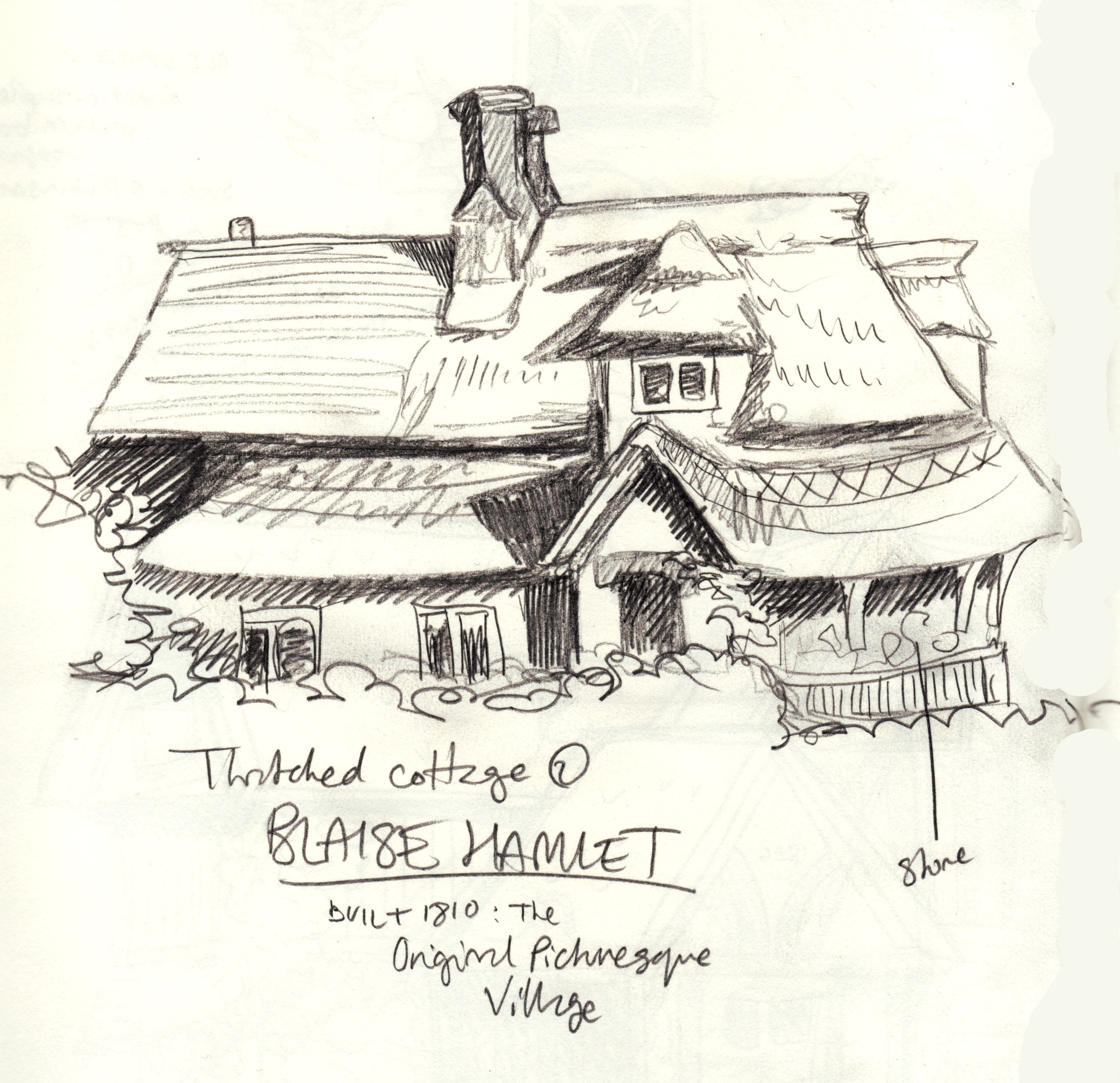
I have been exploring the idea that rural communities are perceived as the heart of some 'real' Britain, despite widespread urbanisation and the decline of countryside values. Now it seems that even the romantic vision of the chocolate-box English village with it's thatched-roofs and half-timbered frames is based on a fabrication. A fashion. A myth.
My oh my.
