
Back on the blog-horse.
It's been a long two weeks, and despite my blog neglection it has been pretty busy too. It's been particularly interesting on the contextual front, and a wealth of new and very clever stuff has implanted itself in my brain courtesy of people like Benedict Anderson and Arjun Appadurai. On top of this, some very clever and inspiring artists like Karen Guthrie and Nina Pope, Tom Hunter and James McKinnon, as well as Goldsmiths' very own Pete Rodgers have given me more than my fair portion's food for thought. But, if I go on like this the word count of this blog post will be longer than my dissertation.
So what follows is a very brief summary of how my project has changed and evolved over the last two weeks or so. I really hope it makes sense...
Last week I wrote a bit about Urban myth and legend, having been interested in Nessie and the Black Shuck of Norfolk/Suffolk. I came to wondering about how a character comes to exist on a level of communal consciousness, and how a locality's desire to make tangible some recognition of its existance- within their minds- results in a system of half-belief: we know it's not real yet we like to treat it as though it could be. In other words, we'd like to remember it that way. In Bungay, the local running club is named after a hell-hound.
"The long-term reproduction of a neighbourhood that is simultaneously practiced, valued and taken-for-granted depends on the seamless interaction of localised spaces and times with local subjects possessed of the knowledge to reproduce locality." (Appadurai, 1996)
From here, I've become extremely interested in collective memory, knowledge and remembering. I've already discovered a lot of evidence that suggests that familiarity within our environments (knowing the history, people, stories and physical spaces) precipitates contentedness and community. It is almost certainly this that makes the tight-knit rural communities of England seem so ideal. They visualise and mark their history, they tell stories and talk about local heroes and gossip. Adapting Marx: "local knowledge is not only in itself, but of itself."
So I've been investigating communal knowledge, memory (Benedict Anderson has some wonderful things to say on the subject of Imagined Communities) and nostalgia. Why and how we preserve and value the past, and ways in which we live our history alongside our present.

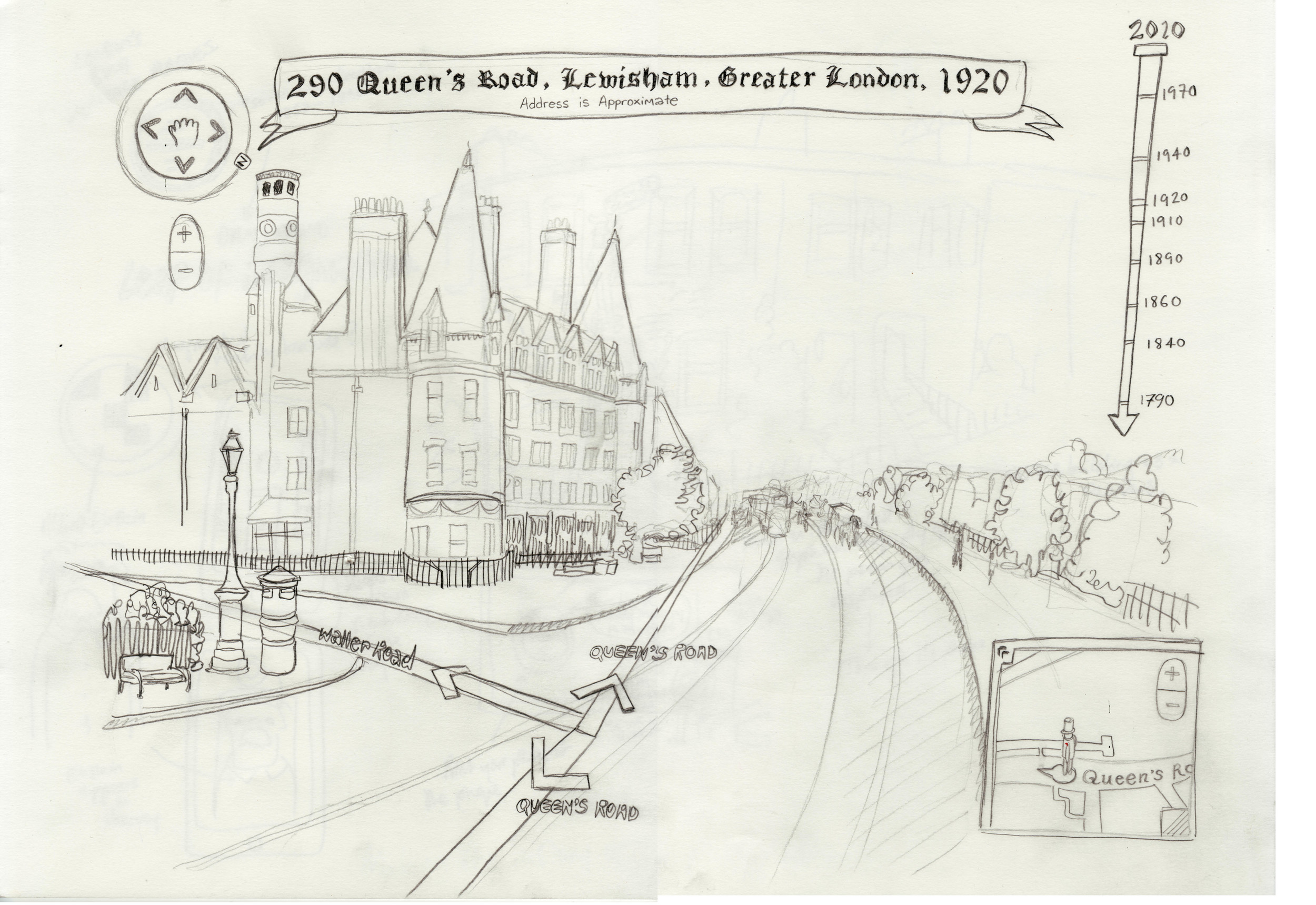
Aaghh, if I hadn't left this post so long I would detail my visits to Dennis Sevvers' house and Museum of London as well as my interview with a Medieval reenactor, but it will take forever...
Thinking about ways in which we memorialise things, I read a lovely quote by the lovely Stephen Fry: "We all pay lip service to the idea that yesterday makes today, but it is difficult to make the imaginative leap that truly connects us to our past... Blue Plaques, in their simple way, address this defect... for me, they are a unique imaginative portal into the past, for in my mind all Blue Plaques are contemporaneous, which is to say, the people commemorated by them are in their buildings now."
I love the blue plaque scheme too, but equally am always left faintly under-satisfied whenever I don't know who someone is, or their situation while they lived there. What if we could make their history more real, more visible?


After my visit to the Museum of London, seeing their London's Voices projects and also discovering the work of somewhere.org and Tom Hunter and James McKinnon's The Ghetto, I've become more interested in the idea of subjective histories or stories becoming part of a general community memory or consciousness. In Robbie (the medieval reenactor)'s words: The battle takes shape through a "multiplicity of subjective curators". And in the same way, a picture of a history (accurate or not) is painted on a woven tapestry of personal reminiscence. I LOVE this.

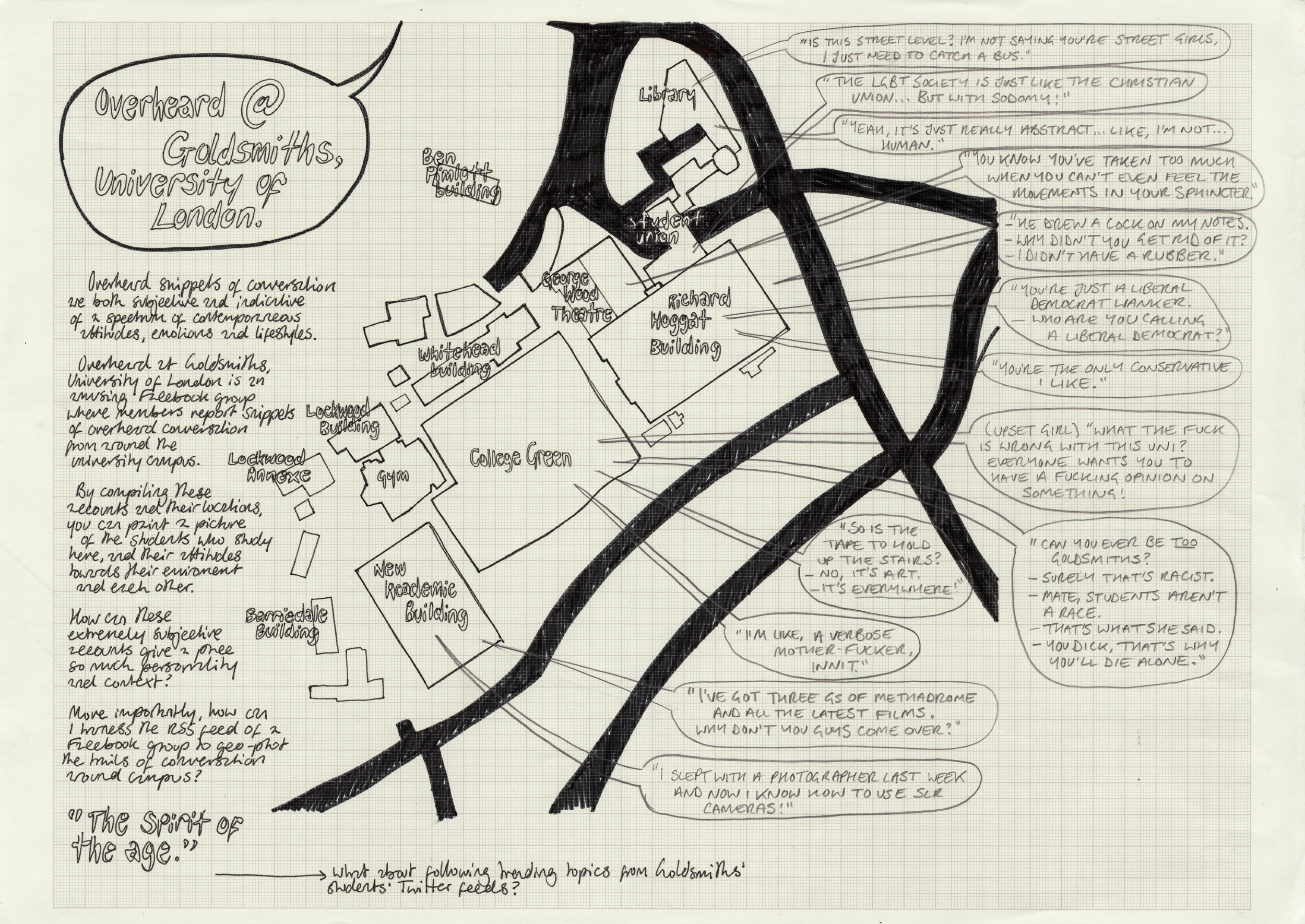
All of these thoughts and ideas are very much in their emryonic stages at this point, but I'm feeling pretty good about this.
My mantra has become 'Stories are inclusive'. Now I just need to find some stories!
Uh-oh: tangent
Uh oh...
I'm having what you might call a 'hiccup'. It's been an odd week. I crashed my car which wrote Tuesday off (amongst other things), and Wednesday I gave my Territories presentation. Possibly the worst presentation of my life I might add- I hadn't practiced and the allotted five minutes ran into fifteen. Shit. Now I have a cold. And all I seem capable of doing is sitting in bed thinking myself into holes.
This is going to be another one of those trail-of-thought honesty rants. Advance apologies.
The feedback from my (dire) presentation made me realise a few things: a) Urban chintz and decoration has been done to death. And better than I could ever do it, by him, him and these guys. b) Villages already exist in London (well, I already knew this but have been resisting it) so what point am I trying to make by blending these aesthetics? c) I'm looking too big, I need to design for something/someone specific. d) I need to establish a user.
and aside from all of this,
I STILL CAN'T GET FLIPPING MAPS OUT OF MY HEAD.
What is it exactly I'm trying to achieve here? What am I originally interested in about villages?
- Engagement with your environment and how it shapes your identity, and the ties we form with the physical landscape.
- British identity and nostalgia- why is it so wrapped up in the image of the countryside?
- Collective memory- stories and events exclusive to a community that help make it unique.
The other day I found this:

It's a map of Deptford and New Cross from 1840. As it turns out, most of it was still fields back then. A village overspill of London, if you like. It made me realise- on a deeper level- the history and human-ness that is all around and yet completely invisible to me. I realised also, that any sense of belonging to a place comes from familiarity, and the memories that bind themselves to the physicality of the world around you.
I have already discovered that happiness and contentment within your environment comes from familiarity, and the nostalgia of lost memories. I conducted a small survey (and by small, I mean 20 people or so) a couple of weeks ago, and the results showed that a person will almost always remember being happier in the place they grew up- the place where all the relationships are already formed. Reminiscent nostalgia.
Some other research I've found particularly interesting is the overwhelming tendency for the elderly to retire to the countryside. The inherent nostalgia of the place beckons even those that have never set foot outside a city before. And according to the reading I've been doing on various retirement forums, a lot of the time the new environment- away from familiar sights and relationships, friends and families- can result in some unhappy twilight years.
So. With all this in mind, I've been thinking there could be a lot of potential in talking to London's elderly population. Why are so many inclined to leave? What are the perks or problems of being retired in the city? What has changed? All of these could open fantastic potential avenues for design, but essentially, I just want to hear their stories. If community life is entangled in memory, then can't I somehow borrow somebody else's? What if I could make these stories and memories tangible?
So then I started thinking- how can you make a memory physical?

Here is a map of my childhood memories. Not the memories themselves per cé, but the locations I find them enveloped in. It in no way represents geographical accuracy, but it means familiarity: locations functioning as thought-anchors for my reminiscences. I find this concept of psycho-geography fascinating.
What if I could make maps of nostalgia. Telling tales about London from the people who've grown old here. Could this somehow work to transfer reminiscent affection from its origin to a new user, to help nurture a sense of familiarity, and thus community and contentment?
My head hurts. And this is a big tangent. Is this wrong? I don't know... but I'm still retaining my core themes: Environment and familiarity, nostalgia and romance. It's just not quite Villages any more is it?
Some pretty nifty research tings....
 Yesterday, not really knowing where to begin with my research and desperately needing to leave my house, I headed off to the Tate Britain. Although not completely useful it at least set me on the right track. I have worked out that I am more interested in the PERCEPTIONS that we have about the countryside, the way its inhabitants DEFINE and PROJECT their identity, and what forms this takes.
I read an interesting piece courtesy the Museum of English Rural Life which attempts to tell the story of the 20th Century countryside through artefacts. [Ref. Onkar Kular- whose exhibition I Cling to Virtue blew my mind at the V&A last week] Rather than going down the usual plough wheels and farm machinery route however, they've chosen to exhibit some icons of the countryside that have transcended rural into mainstream culture. Examples are: 
The barbour jacket, "something that began as required wear for your average hunt follower, is now to be found being sported by Lily Allen and the like."
 The Land Rover: "which first appeared in 1948 as a general purpose farming vehicle but which subsequently managed to mutate into a fashionable vehicle of choice for the metropolitan elite."

...and the Aga, "which emanated from Sweden and was brought to this country in the 1920s. By the 1950s it had become indelibly associated with the farmhouse kitchen and from thence it became not only a style icon but a potent class symbol of the second half of the twentieth century."
I liked this statement best: "If the right Landrover or the right Aga come along with the right story, we’ll collect them." ...so I'll be making the trip down to this collection in Reading quite soon I think.
As well as this, my flatmate studies media, and happened to have a book entitled British Culture, which contains an essay entitled Rurality and English Culture by Alun Howkins. Convenient eh? From this essay, I've drawn out several of his key observations about how the British relate to ideals of rural life:

- The perception that rural life is in decline has rallied communities around a 'stirring and practically based image of threatened belonging'.
- Images of pastoral beauty have been ingrained in our national sense of identity chiefly by war propaganda. Posters and official war songs including 'There'll Always be England' and 'Bluebirds over the white cliffs of Dover', and the deliberate icon of the war memorial on the village green were used to rally England under a collective National ideology.
- Rural Britain is at the heart of an idealised vision of 'real' England. The countryside has certain aesthetic specifications: Rolling hills interspersed with woodland, hedgerows lining fields. "even more importantly its ideal social structure is village with its green, pub and church clustered together. Ideal architecture stone or half-timbered topped with thatch."
- "Aesthetics, ruralistic impulse and urban decline created our image of the 'real' England: “...even before the first World War, this ideal landscape had ceased to be an exact geographical location and had become instead a set of features by which rural beauty was defined. The bringing together, before the Great War, of an elite view of urban and rural decline, a ruralist impulse, and an aesthetic of the southern created an ideal of the countryside which, all too often and too easily become 'real' England.”
So the set of criteria for which we base our vision of the countryside- the 'heart of true England' is fabricated upon a set of upper-class aesthetics and lifestyle ideologies. I like the idea that there is a formula of British Countryside.
If the image of the real Britain is false, then is a community's collective identity just imagined too?
And so, Villages it is...
What a coincidence. Just last week I was thinking about villages: identity and stereotypes. We're assigned to open the paper and draw out an issue from any article we liked, and guess what?

So, I guess that's fate deciding that villages it is! So yesterday was spent trying to figure out exactly what it was about villages I was really interested in. And I settled on...
How do Rural Communities form an identity for themselves?
The article above featured brief stories about villages throughout the UK- their idicoyncracies, their bizarre customs and rituals, their historic signifigance...

I love the idea that communities come together under shared rituals. And in this case, the symbol of the Hare Pie is a rallying symbol for the whole village. When it was threatened one year by the village Pastor (because of its rumoured Pagan origins) the slogan 'No Pie, No Pastor' was found dawbed acr0ss the church walls the next day. A worthless pie, priceless in symbolic value.
My research routes will be:
- Weird Village Traditions
- Pastoral Iconography and Identity
- British rural perceptions and projections
Material Definitions
[gallery columns="4"] Over my lifetime I have accumulated a lot of crap. Ragged cuddly toys I've owned since the beginning of time mold contently at the back of my cupboards; boxes overflowing with scraps of paper-tickets, doodles, letters, certificates gather dust on top of shelves; nick-nacks, torn-up books, photographs I'll never put in frames and bits that have fallen off other bits that I won't throw away just in case they come in useful again adorn every available surface.
I love clutter. I immerse myself in these bits of junk that mean nothing and everything. I collect antique cameras that I never uses, broken watches I'll never repair, and stacks upon stacks of books that I'll probably never read. Why?
I am fascinated by the qualities we project onto our possessions. I'm sure this sounds familiar. Marxist theories of Commodity fetishism have been boggling my mind for a while now, and my interest in human relationships with their material environment has been ongoing since I can remember.
They say that the whole is greater than the sum of its parts, and I believe this statement applies to personal expression through possession perfectly. That is to say, a single book; a single pen, a lamp or chair would not go far in defining a person's character as a whole. However, when put together, a selection of miscellaneous objects can weave a portrait with their symbolism, their attributed qualities, the roots of their implications.

How do we read a person's possessions? How do we draw conclusions about intangible assets through readings of tangible ones? How do we select what we consume by way of expressing the way we see ourselves, and how accurately do our possessions reflect the truth about us? Are we influenced in our opinions of others through what they own? How can we use objects to construct a narrative around an individual?
The Visual Essay

We live in an increasingly less literate society. By this I do not mean that we are becoming illiterate. But that we are reading less. Why is this? There are multiple factors: TV, fast-paced culture and a shift in prevalent cultural values have made us lazy. We have less disposable time, and so seek instant gratification. Entertainment and leisure overriding education and intellectualism as lifestyle qualities.
We inhabit a visual culture that constantly bombards us with striking imagery, containing layers of cognitive meaning and complexity that we are able to process almost instantly.
 As this Visual culture continues to gather momentum, the nature of more traditional communication media is being forced to evolve along with it. Magazines for example- with tabloid-style publications like 'Zoo' and 'Heat', we no longer have to 'read' a magazine; but rather we 'watch it'. Articles will feature an image, a headline, and a brief descriptive strap-line so that you can get the entire gist of the feature without reading more than three sentences. Information is structured in clear, easy-to-follow formulas like bulleted lists, and typography is designed to keep your eyes constantly stimulated.
It is probably no coincidence then that the popularity of graphic novels has grown tremendously over the course of the last decade. According to industry observer ICv2, sales of graphic novels in the US and Canada has grown from $75 million in 2001, to $375 million in 2007.

So everybody likes superheroes, right? Wrong. Comic books are rising to their new-found position as a valid literary form- the birth of the Graphic Novel. Now that medium too is evolving. In Web 2.0, the popularity of the web comic is growing, and the possibilities for the graphic novel as both an artistic and literary format in its own right are just being discovered...
Is there something in information structured by imagery that makes it clearer, or easier to understand? Or is it just a case of attractive visual stimulation and laziness of the everyday user?
Either way... I do kind of love it. And I say that as an ardent reader.

References:
- Rick Poynor- Obey the Giant
- Scott McCloud's books and Ted Talk.
- A large collection of comic books.
Why Do Rational People Hate to Tempt Fate?
Superstition is embedded in us. I recently read this article at Spring.org.uk "We absorb superstitions from around us, especially vigilant for their occurrence and reinforced by any events that fit the pattern, conveniently forgetting events that don't fit."

Logical people do not want to wear a murderer's jumper (Sean Hall- find notes)
When we're kids we can believe that our toys might come alive at night, that Father Christmas comes down the chimney or that there's a monster under the bed. It is only after we accumulate experience that our sense of 'magic' is dispelled and we begin to lose our naivity and willingness to believe in phenomena.
Aside from things like religion, paranoid UFO enthusiasts and superstitious old ladies (let's call these cases to compare against) we mostly live in an age and culture of cynicism and disbelief.
What interests me about the above article, is that it suggests that rather than being merely naivity or a willingness to believe in irrational phenomena it is something that is imbedded in us- part of our psychological make-up. If this is true I'd like to know why, how this might have manifested itself throughout time, and how I might be able to exploit this fact to recapture the imagination of even the most disenchanted critic.
I want to research and investigate ways in which superstition, mythology and fantasy form an integral part of the tapestry of our lives. Folklore and stories affecting behaviour- social ritual and ceremony.
How can I weave a bit of magic back into life?

- Immersive environments,
- experiential design,
- artefacts.
- Ways in which superstitions are already exploited.
- Psychological causes and effects of superstition
Something to believe in
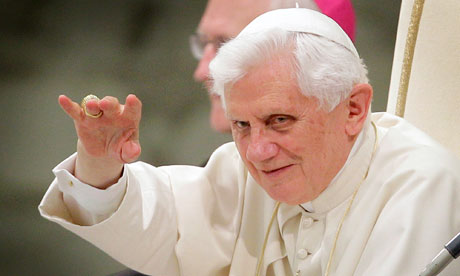
Britain was recently described by the Pope's aide Cardinal Walter Kasper as a "third-world country". An amusingly provocative statement, and a rather poor analogy for our country's famine of faith. He subsequently was dropped from the Pope's widely-publicised trip to the UK, 'for health-reasons'. Was he was referring to the fact that we are a secularly-governed society? I wonder if he would then consider India, arguably still considered 'third-world' (if we're using the outdated terminology) the same way?
What I find interesting is the way Cardinal Kasper phrased his poorly-considered aspersion on Britain. The way he so directly compared the value of faith to material wealth.
In the age and culture of unbelief that we find ourselves occupying, how else can we comprehensively descibe an intangiable thing's worth but to compare it with something monetary or material?
Last year, I read American Gods by Neil Gaiman. You've got to read it, it's flipping brilliant.

We follow the protagonist known only as 'Shadow', who has been released from prison to find that his wife has died in a car-accident. Whilst sucking his best friend's cock. Left with nothing, when he's offered a job by a mysterious dude known as Mr. Wednesday he takes it.
I can't be bothered to write a full plot summary, so SPOILER ALERT! Here is the jist of it:
Mr. Wednesday is Odin. And Odin is preparing for war. Old gods vs. new. The old gods are all that you could possibly imagine, from the Egyptian sun-god Ra to the Caribbean trickster Ananse. They have arrived and are sustained in the 'new land' by the fading trickles of belief that still comes from human minds. If someone- anyone- is still praying then the old gods exist, occupying both this world (where they live amongst us in disguise) and the dimension alongside it. Mythology overflowing into our familiar reality.
What makes American Gods truly fascinating however, is the New Gods. The god of television- with her perfect pin-stripe suit and dazzling smile, and Tech Boy- pale and covered in spots, but greedy and murderous. It goes on and on- from the god of Freeways to the Internet- set to become the New Gods' head-hancho.
It's his comparison of religious and corporate iconography that gets me. It's fucking genius. It's human recourse to turn to something beyond ourselves for comfort, distraction, purpose and meaning. It's just that nowadays we do it with Heat magazine instead.

Will Self says it pretty well in The Book of Dave. Set 500 years A.D. (After Dave). Dave is a schizophrenic cab driver in London whose wife buggers off with his child. We follow as he goes slowly mad, eventually creating his own religion based on the London cabbing 'Knowledge'. He has his religion engraved into a metal book and buries it at the end of his ex-wife's garden. Hundreds or thousands (we never know- but pigs have evloved) of years later, his book has been dug up and Davism adapted as the primary religion of the mostly submerged principality of 'Ing'. Everyone chats Mockney (the generic term for a hot meal is "curry" and for breakfast, "Starbucks") and Mummies and Daddies share custody of children, the 'Changeover' reflecting the ritualistic aspects of Dave Rudman's 21st century life.
A parody of modern religion and blind faith, Self "challenges the assumption of whether people should follow something just because it is written in an old book."
Personally, I am agnostic. Or a "fucking fence-sitter" if described by Professor Richard Dawkins.
Just a meandering little thought. Not really sure where this one is going.
Wells Blog
Duis mollis, est non commodo luctus, nisi erat porttitor ligula, eget lacinia odio sem nec elit. Maecenas faucibus mollis interdum. Nulla vitae elit libero, a pharetra augue.


Commodo cursus magna, vel scelerisque nisl consectetur et. Donec id elit non mi porta gravida at eget metus.