
Future Nostalgia?
I've found a DIAMOND book in the library, The Countryside Ideal by Michael Bunce. It's basically about the idealisation of rural life in Anglo-American culture. ie: why we idealise the countryside, how we idealise it and the projections and assumptions that we make about life there. It discusses how attitudes toward the countryside are as a result of urbanism and industrialisation. If the population of Britain's countryside continues to grow at such an alarming rate (3x the rate of urban environments) and if we continue to aspire to a 'simple, quiet' life in the country, it's not going to be too long until what remains of the rural idyll captured in the national mind's eye is nothing but a story. A myth left over to tell the grandchildren about. It's already happening.
I watched this the other day. It featured a village whose history spanned a thousand years, and in the 1930s featured in a movie showcasing it as a rural utopia- the perfect escape for the middle classes. Years on, the programme takes a look at the same village, talking to a farmer whose old cow-shed is now a £700,000 barn conversion and a city-worker whose two-hour commute home at night crosses paths with a local builder who can trace his family back through the village six generations as he returns to town- no longer able to afford to live the picturesque ideal that is his heritage.

I know I've already rambled about the genius of Will Self's The Book of Dave a few times, but I dragged it out yet again to have a look through the maps in the front. Visions of London underwater at an indeterminable point in the future. It's full of social and cultural references to the present day. Misremembered and misinterpreted scraps of information and tradition that live on in a broken, fragmented kind of way amidst the new, future culture of Ing (England).
Why do we reflect on lost times and ways of life and elevate them as ideals? Why will yesterday always seem better than today? Countless historical sites stage historic reenactments. Kentwell Hall in Suffolk is the first that springs to mind. During the summer months, they employ around 70 full-time Tudors who work the land and run the house as they did in the 1500s. Tales of a lost time, when things were simple, folks worked hard and were happy, and wore silly costumes and spoke silly words.
I remember visiting Kentwell Hall on a school trip when I was really small. Completely overwhelmed with the place, my childhood imagination reveled in the idea that I had actually been transported back in time; that these people were actual Tudors. It was wonderful... until I spotted the strip lighting on the ceiling inside one of the cattle sheds. The boards covering it over had not been replaced properly, and the illusion of my escape into another time was shattered.
In as little as thirty years time, it's likely what remains of the culture and traditions of the Countryside will have been warped beyond all recognition. After all, its the people that these qualities live through- not a tangible landscape or object. So, in our future attempts to uncover the lost vision of Britain's countryside what assumptions will we make about it? Will the children of 2050 sit through an granny-style afternoon tea or a Harvest Festival with the same detatched sense of awe that I felt about the ladies churning the butter in Kentwell gardens? Will it be the same? And what form will our idealised communities now take? We're already stumbling into a future where idealised rural-living is artificial, misplaced and misinterpreted (like this), so what will they look like by then?
God of all things good, Russell Davies had a great idea with his Lyddle End project, where he took the charming railway models of fictional picturesque Lyddle End village and asked artists and designers to remodel them as they'll look in 2050. I love this idea that the chinese-whisper effect of history will contort the recognised into something alien. Also, read this. Oh, isn't he so very clever?

So, more stuff to look into. I want to find out more about these funny folks who dress up and relive history in a variety of weird and wonderful ways, and just why they do it. The escapist element is obvious, as is the nostalgic one. But I'm mostly interested in the inaccuracies of what they do. The fuck-ups and faux-pas of the reenactments. Is it the accuracy that matters to them? Or just the illusion that they have- just for a short time- the undesirables of living life today.
If anyone reads this (in my optomism that anyone makes it this far through my rambling) and has any suggestions for reenactment events or venues, or better- knows anyone who likes to get dressed up and have sword-fights I'd love to hear from them. The closest I've come to experiencing this was my 18-month flirt with WOW. And I don't think that quite counts...
The Legend of Black Shuck
Over the past day or two I've been thinking about mythology and folklore. Somehow as yet they are themes that have managed to be left out of this project. This is about to end.

With a bit of a prompt from Onkar, I've been researching the systems through which myths and folklore of 'oldentimes' (lovely expression) manifest themselves in present day. The Loch Ness monster is an obvious example. The Loch Ness lake has built up an enormous tourist economy based predominantly around the legend of the monster (though I'm certain local residents and business-people are sick of it).
It didn't take long to dredge up some pretty rancid tourist crap on the subject. Loch Ness now features a 'nessie' tour and Loch Ness Monster exhibition centre, all dedicated to the history of the mythic beast and the countless fruitless searches for him.


And so, Nessie- imagined or not- lives on in the consciousness of the American tourists who go on his tours and buy his mundane merchandise, the forlorn creature-seekers who sought [the money and accreditation in discovering] him, and the weary tradespeople who capitalise upon him. Is this all the capacity we have for myth and legend in a cynical age?
I thought it might be interesting to look into something a little bit closer to home. The legend of Black Shuck. The stuff of East Anglian legend.

The Black Shuck is a great Black Dog with saucer-like, flaming malevolent eyes who roams the coasts and lonely tracks of Norfolk and Suffolk. He made his first recorded appearance was at 9am on August 4 1577 in St. Mary's Church, Bungay. Abraham Fleming's description in his book A Straunge and Terrible Wunder is amazing:
"This black dog, or the divel in such a linenesse (God hee knoweth al who worketh all,) running all along down the body of the church with great swiftnesse, and incredible haste, among the people, in a visible fourm and shape, passed between two persons, as they were kneeling uppon their knees, and occupied in prayer as it seemed, wrung the necks of them bothe at one instant clene backward, in somuch that even at a mome[n]t where they kneeled, they stra[n]gely dyed."
As the tale goes, the church tower collapsed in on itself and the beastie then ran up the pulpit, disappearing in fire and lightning and leaving scorched claw-marks on the Northern Doors which can still be seen at the church today.
The tale has become ingrained in Norfolk/Suffolk culture, but not only that- the Black Shuck has appeared in many other works of fiction and fantasy since. Most memorably, Arthur Conan Doyle's Hound of the Baskervilles, which he wrote while staying at Cromer Hall, the sight of one of the more famous subsequent sightings of the dog. He's also popped up in a few comics (Hector Plasm, 2000ad's London Falling, Supernatural: Origins), fantasy books (Northern Lights, The Age of Misrule, Harry Potter), a musical play (The Storm Hound by Betty Roe and Marian Lines), and had songs written about him (Nick Drake's Black-Eyed Dog, The Darkness' Black Shuck). Apparently he's even a boss in both MMORPG Lusternia and Final Fantasy XI!
It made me think of this appalling set of images found in the kiddies' section of Nessieland.com:


It's interesting that we treat these stories like public property- no copyright law applies here. We have the right to take the characters and brazenly plonk them into any scenario, medium or context we like. It's almost as if Nessie- as well as Black Shuck- exist on a plain of National consciousness, inhabiting the public imagination. After all, isn't that how the myths and legends bred in the first place?
There have been no less than a further 153 supposed encounters with the legendary Black Shuck since it first appeared in Bungay in the 16th century. And there is a man who has collected and documented every single one of them. I mapped them. Why not?

Mike Burgess is the man, and wow- what a man. Not only has he recorded, edited, interviewed and categorised his way through every single one of these 153 tales, he has written about the misconceived similarities between Shuck and other beasties (such as the ghosts of people's pets, the Moddey Dhoo and the Snarleyow), and origins of the legend being from the Vikings (their's is different). As well as this he has collected and analysed data of all the recorded encounters and legends and written a five-part essay entitled (gloriously): Analysing the Hell out of the Beast.
This actually helped to distract me from my original Shuck fact-finding mission. Just who are these people? These myth-seekers and fantasy-detectives who are so fascinated and become so obsessed with myths and folklore. Another method of escaping a hard and cynical world- harking back to the days of ghosts and monsters. It's made me want to watch Mythbusters, actually. After all... what's not interesting about this man?
.... just some stuff to think about.


Trip to Thorpeness- the Peter Pan village
I am seriously pissed off as I just spent a bloody hour writing, editing and formatting this pissing post only for it to disappear. NOT IMPRESSED WORDPRESS.[gallery columns="4"] As such, I really can't be bothered to re-type it all.
I wanted to get as much research done as possible while I was actually out in the countryside. So, on Wednesday me and my parents went on a jolly day outing to Thorpeness, the bizarre Victorian private fantasy holiday village. The only one of its kind in England.
It was bloody fascinating to go there- a kind of stage-set of a place. Weird ornamental architecture and more Peter-Pan references than you could shake a stick at.
But has it helped me further or expand my project..?
I'm a bit lost now to be honest.
(I'll post more about Thorpeness' history when I'm not so cross)
Arts and Crafts day...
Seeing as it's image week and I'm doing a project about villages, I thought it might be sensible to actually go to one. So here I am, back on the sunny Norfolk/Suffolk divide in the heart of lovely rural East Anglia. Smell that Autumn air. And complain about the weather, because it's absolutely pissing it down. Not quite sure where to start, I went on an inspiration mission looking for images that might effectively 'capture the essence' of what the Villages project is all about. Seeing as I myself am not yet sure about this, I thought this could be a little bit of a struggle. Out on my little drive, one thought immediately struck me: the countryside ain't always quite as pretty as you expect...
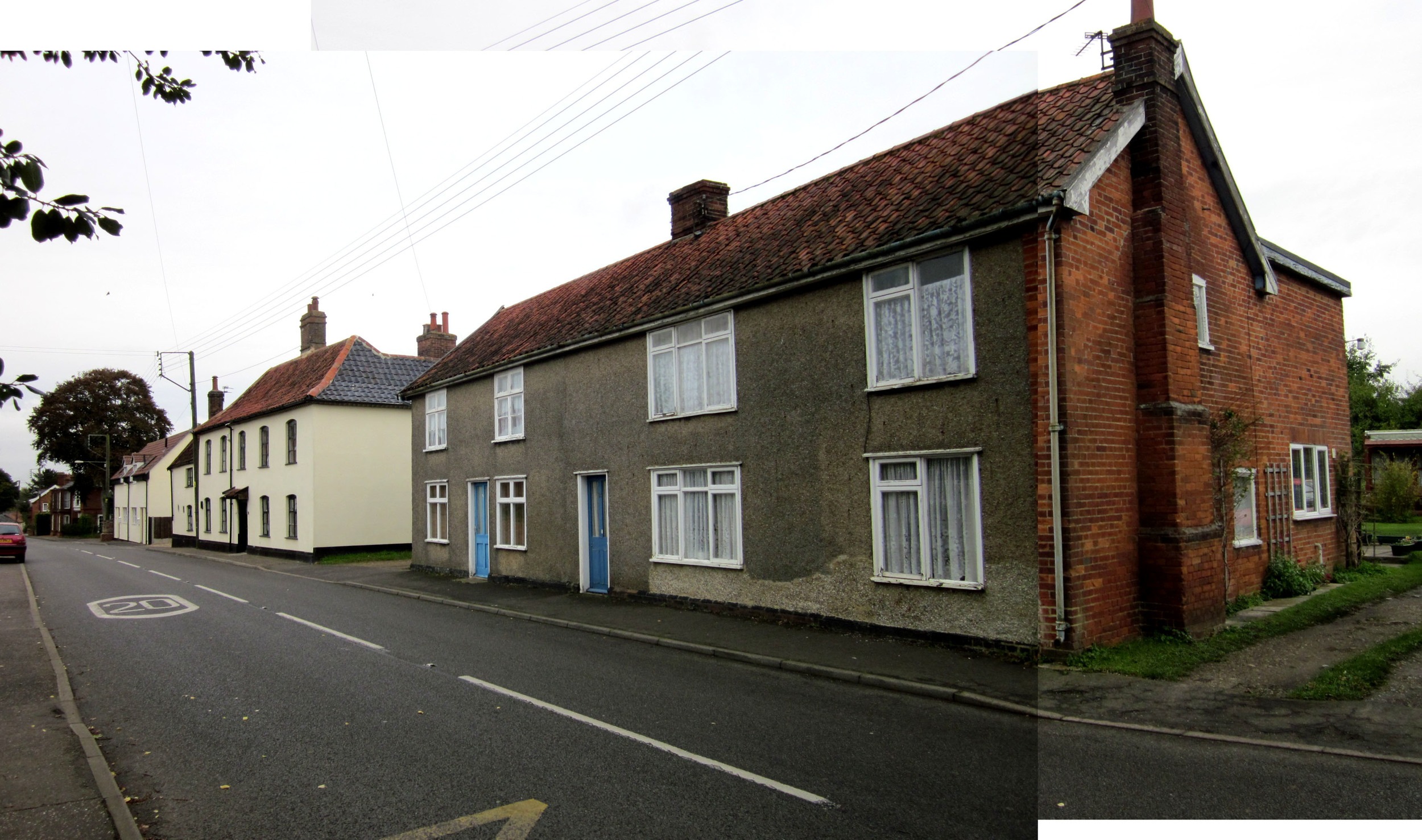
But in general, the area does still come wrapped up in a chocolate-box bow. All over the place there are still signs for village fêtes and farm-shops, and the local paper shop is rammed with historical books about the area. These countryside folk really are happy to be so. I forget this sometimes now that I'm down in London nearly all year. The ideal of country living is alive and kicking. So, even if it's not always as pretty as we think it should be, the ethos lives on regardless.
My project has been very wrapped up in aesthetics so far. The images we rally around, the ones we hide behind, the ones we project in order to represent how truly lovely it is to be in the countryside. There's a simple and charming naïvity to it. And this was what I decided to try and capture.
I went on a little road-trip collecting photos with my shitty compact camera in the dismal weather, and successfully came back with a whole heap of examples of buildings found in typical rural idyll...


But the light was crap, and it got wetter and colder until I couldn't even be arsed getting out of the car. Feeling like a bit of a child I ventured to the local toy shop and bought a load of PVA, coloured card and crêpe paper, before buggering off home to a cup of tea, my mummy and some quality rainy-day activities...
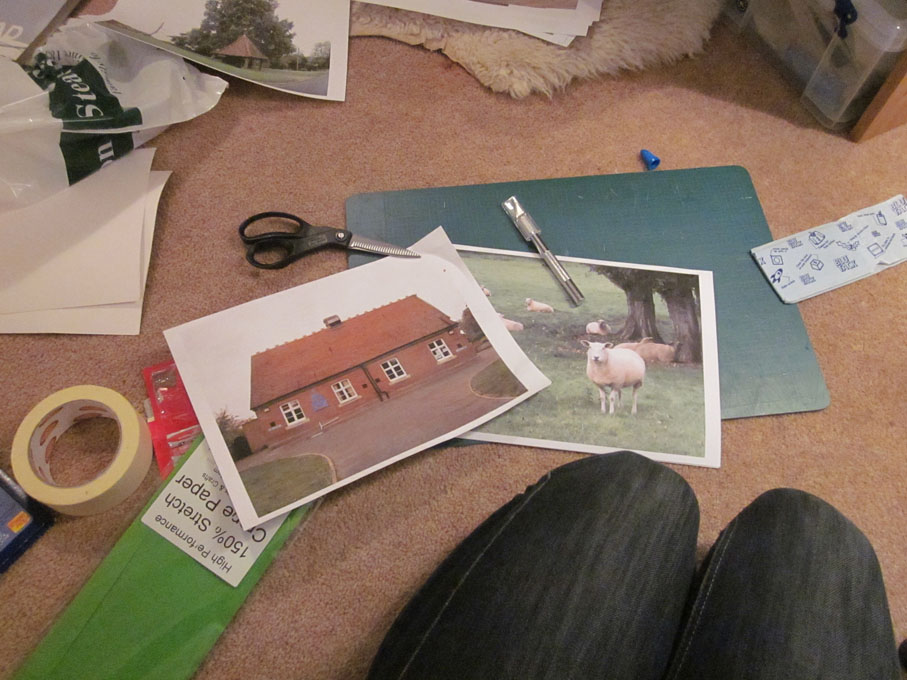


I had the idea of like a nativity tableau... you know how they look like a proper three-dimensional scene but as soon as you move a bit you realise they're just flimsy bits of card and straw? The thought is sincere,but it's also a little naïve and idealistic- a bit of a fantasy, really. And their's no denying that although the final product may look pretty enough from the right angle, ultimately, it's only gonna fall over or get trodden on...

I had a lot of trouble getting a good shot. Lighting was hilarious. I think I must have had every single lamp in the house gathered around my desk. I've been using my Canon compact for everything, and as my parents are also techno-phobes their was no SLR or DSLR to be found. Sadly I have had to make do with my final photograph...

Yes, I am a child. A bad-at-photography child. But I had a very fun day.
(PS. Chris, does this constitute 'messy play'?)
The Visual Essay

We live in an increasingly less literate society. By this I do not mean that we are becoming illiterate. But that we are reading less. Why is this? There are multiple factors: TV, fast-paced culture and a shift in prevalent cultural values have made us lazy. We have less disposable time, and so seek instant gratification. Entertainment and leisure overriding education and intellectualism as lifestyle qualities.
We inhabit a visual culture that constantly bombards us with striking imagery, containing layers of cognitive meaning and complexity that we are able to process almost instantly.
 As this Visual culture continues to gather momentum, the nature of more traditional communication media is being forced to evolve along with it. Magazines for example- with tabloid-style publications like 'Zoo' and 'Heat', we no longer have to 'read' a magazine; but rather we 'watch it'. Articles will feature an image, a headline, and a brief descriptive strap-line so that you can get the entire gist of the feature without reading more than three sentences. Information is structured in clear, easy-to-follow formulas like bulleted lists, and typography is designed to keep your eyes constantly stimulated.
It is probably no coincidence then that the popularity of graphic novels has grown tremendously over the course of the last decade. According to industry observer ICv2, sales of graphic novels in the US and Canada has grown from $75 million in 2001, to $375 million in 2007.

So everybody likes superheroes, right? Wrong. Comic books are rising to their new-found position as a valid literary form- the birth of the Graphic Novel. Now that medium too is evolving. In Web 2.0, the popularity of the web comic is growing, and the possibilities for the graphic novel as both an artistic and literary format in its own right are just being discovered...
Is there something in information structured by imagery that makes it clearer, or easier to understand? Or is it just a case of attractive visual stimulation and laziness of the everyday user?
Either way... I do kind of love it. And I say that as an ardent reader.

References:
- Rick Poynor- Obey the Giant
- Scott McCloud's books and Ted Talk.
- A large collection of comic books.
Why Do Rational People Hate to Tempt Fate?
Superstition is embedded in us. I recently read this article at Spring.org.uk "We absorb superstitions from around us, especially vigilant for their occurrence and reinforced by any events that fit the pattern, conveniently forgetting events that don't fit."

Logical people do not want to wear a murderer's jumper (Sean Hall- find notes)
When we're kids we can believe that our toys might come alive at night, that Father Christmas comes down the chimney or that there's a monster under the bed. It is only after we accumulate experience that our sense of 'magic' is dispelled and we begin to lose our naivity and willingness to believe in phenomena.
Aside from things like religion, paranoid UFO enthusiasts and superstitious old ladies (let's call these cases to compare against) we mostly live in an age and culture of cynicism and disbelief.
What interests me about the above article, is that it suggests that rather than being merely naivity or a willingness to believe in irrational phenomena it is something that is imbedded in us- part of our psychological make-up. If this is true I'd like to know why, how this might have manifested itself throughout time, and how I might be able to exploit this fact to recapture the imagination of even the most disenchanted critic.
I want to research and investigate ways in which superstition, mythology and fantasy form an integral part of the tapestry of our lives. Folklore and stories affecting behaviour- social ritual and ceremony.
How can I weave a bit of magic back into life?

- Immersive environments,
- experiential design,
- artefacts.
- Ways in which superstitions are already exploited.
- Psychological causes and effects of superstition
Something to believe in

Britain was recently described by the Pope's aide Cardinal Walter Kasper as a "third-world country". An amusingly provocative statement, and a rather poor analogy for our country's famine of faith. He subsequently was dropped from the Pope's widely-publicised trip to the UK, 'for health-reasons'. Was he was referring to the fact that we are a secularly-governed society? I wonder if he would then consider India, arguably still considered 'third-world' (if we're using the outdated terminology) the same way?
What I find interesting is the way Cardinal Kasper phrased his poorly-considered aspersion on Britain. The way he so directly compared the value of faith to material wealth.
In the age and culture of unbelief that we find ourselves occupying, how else can we comprehensively descibe an intangiable thing's worth but to compare it with something monetary or material?
Last year, I read American Gods by Neil Gaiman. You've got to read it, it's flipping brilliant.

We follow the protagonist known only as 'Shadow', who has been released from prison to find that his wife has died in a car-accident. Whilst sucking his best friend's cock. Left with nothing, when he's offered a job by a mysterious dude known as Mr. Wednesday he takes it.
I can't be bothered to write a full plot summary, so SPOILER ALERT! Here is the jist of it:
Mr. Wednesday is Odin. And Odin is preparing for war. Old gods vs. new. The old gods are all that you could possibly imagine, from the Egyptian sun-god Ra to the Caribbean trickster Ananse. They have arrived and are sustained in the 'new land' by the fading trickles of belief that still comes from human minds. If someone- anyone- is still praying then the old gods exist, occupying both this world (where they live amongst us in disguise) and the dimension alongside it. Mythology overflowing into our familiar reality.
What makes American Gods truly fascinating however, is the New Gods. The god of television- with her perfect pin-stripe suit and dazzling smile, and Tech Boy- pale and covered in spots, but greedy and murderous. It goes on and on- from the god of Freeways to the Internet- set to become the New Gods' head-hancho.
It's his comparison of religious and corporate iconography that gets me. It's fucking genius. It's human recourse to turn to something beyond ourselves for comfort, distraction, purpose and meaning. It's just that nowadays we do it with Heat magazine instead.

Will Self says it pretty well in The Book of Dave. Set 500 years A.D. (After Dave). Dave is a schizophrenic cab driver in London whose wife buggers off with his child. We follow as he goes slowly mad, eventually creating his own religion based on the London cabbing 'Knowledge'. He has his religion engraved into a metal book and buries it at the end of his ex-wife's garden. Hundreds or thousands (we never know- but pigs have evloved) of years later, his book has been dug up and Davism adapted as the primary religion of the mostly submerged principality of 'Ing'. Everyone chats Mockney (the generic term for a hot meal is "curry" and for breakfast, "Starbucks") and Mummies and Daddies share custody of children, the 'Changeover' reflecting the ritualistic aspects of Dave Rudman's 21st century life.
A parody of modern religion and blind faith, Self "challenges the assumption of whether people should follow something just because it is written in an old book."
Personally, I am agnostic. Or a "fucking fence-sitter" if described by Professor Richard Dawkins.
Just a meandering little thought. Not really sure where this one is going.
Wells Blog
Duis mollis, est non commodo luctus, nisi erat porttitor ligula, eget lacinia odio sem nec elit. Maecenas faucibus mollis interdum. Nulla vitae elit libero, a pharetra augue.


Commodo cursus magna, vel scelerisque nisl consectetur et. Donec id elit non mi porta gravida at eget metus.