
Excalibur

It's a drizzly day in South East London, and I'm weaving my way through the mazes of Lewisham's council estates, which only seem to amplify the weather. The homogenous grey terraces and flat blocks are grey in both colour and nature. I'm on my way to Catford, and the Excalibur Estate.

In case you're unfamiliar with the Excalibur Estate- where the streets are named after Arthurian legend- it is the largest remaining post-war prefab community in Europe, and the only one left in London. Built in 1948 by German and Italian prisoners of war to rehouse those left homeless by the blitz, the prefabs were designed to last between 10-15 years, but after more than sixty, they're still standing- and so is the community that has grown up around them. Despite six years of tireless campaigning by local residents and English Heritage, the future of Excalibur is looking bleak. The council have approved plans to 'regenerate' the estate- the historical prefabs will be torn down, to make way for yet another block of flats.
 Jim and Lorraine Blackender formed the Worried Tenants Group in opposition to the proposed demolition of their community, and kindly invited me into their (beautiful) home. They have been living in their prefab on Excalibur for twenty years, but the last six years have been a whirlwind of bureaucracy, media hype and worry. The thing is, this is more than a bunch of prefab homes, more than an marker of working-class history, more than roof over their heads- this is a thriving community, and the most exceptional phenomenon of neighbourliness remaining in what is our frequently alienated city. There are generations of families living alongside each other. Some residents have been here since the estate was erected. It has such a low crime rate that the police no longer even bother to patrol here, and kids can play safely in the street- parents comforted by the fact that there will always be a pair of friendly eyes to watch over them.

The residents of Excalibur are bound together by the history of the estate, as well as the buildings themselves. The buildings are what make the community- and despite Lewisham councils assurances that it will keep the community together after demolition- Jim and Lorraine know that the reality will be just another council estate with all the distrust, alienation and crime that that brings with it.
"There are waiting lists of people who want to live in a prefab on the estate. In the council flats across the road the waiting list is to get out."

You can read all about the efforts being made to rescue the Excalibur estate at Jim's campaign website as well as in numerous national press articles from the past few years (just Google search).
My project to date has been about investigating communities. Why do we have such successful tight-knit communities out in the sticks (where I'm from) and yet in the cities any sense of human significance is lost? The Excalibur estate shows that communities can and do exist within the city limits, and they're as wonderful if not better than anything you'll find in the countryside.There are people who dedicate their lives to conserving, rescuing, and building communities every day, but their stories and their efforts are disappearing into the mists of time- just like our sense of neighbourliness.

History frames and contextualises our sense of place- our sense of each other. Maybe we're making the wrong kind of history memorable. What if what's available in the history books and museums isn't good enough? Fuck the hard facts of battle dates and grandiose architecture, this is what really matters. This is the kind of history that's relevant.
And if we don't know about it, if we are unaware that there is anything there to preserve, then who is going to do anything about it?

My mission is hence to tell the stories of the communities and individuals who are struggling tirelessly against the individualism and distrust that thrives. They are still here, they do deserve our attention. I'm going to help them get it.
Consolidating rant...
What follows is the first draft copy+paste of what I had intended to be a simple outline of my project. What it actually is is a load of meandering thought-trails, lists, non-sensical grammar and some probably quite rubbish ideas. But who cares? This is where I'm at right now:

------------------------------------
So I've been a bit stuck this week.
I've managed to produce a few bits and pieces, but the 'flow' has all but left me. I'm sure that this is more a reflection on me than on my subject matter.
Last night I sat down and tried to form some cohesion of my interests and themes that have manifested themselves in my little endeavours so far. I don't think that I'm analysing my motives hard enough.
The most important themes present in my work so far have been:
- -Nostalgia
- -Village Environment Aesthetics
- -Symbolism
- -Naivity/ Childishness
and my key points of research have been:
- -Projection and manifestation of Stereotypes (miniature villages etc)
- -Model and utopian Villages (Thorpeness)
- -Happiness and environment
- -Community identity
- -Personal Geographies and escapism
------------------------------------
My most recent and more specific statistical findings include:
- -People who have lived in the same place for more than 5 years are more likely to be happier. Thus, familiarity = happiness. (not just because you live in a village) (Source: The Happiness Formula, BBC 2008)
GFKNOP.com Consumer Trends: Nostalgia Report:
Recession provoking nostalgia: 62% consumers experienced a negative monetary experience in past year, 23% positive one. When things are crap in the now, we escape by looking forward to when times will be better, or by looking back to when times were better. Because nobody knows what the future holds, it is easier to look back. Evidence:
- Resurgence of nostalgic brands: Arctic Rolls, Wispa bars (hurrah!), Birds Custard
- Revival of bands and musical styles: Take That, 80s Synth: The Killers La Roux
- Movies and TV: Dr Who, Life on Mars, A-Team etc.
- 'Retro Styling, Modern Function': Beatle, Mini, Fiat
- Emphasis on heritage (trustworthiness): Persil "Tough but gentle for 100 years"; Hovis "As good today as it's ever been"; M&S "125 years since the penny bazaar"
*NOSTALGIA 2.0: Like the first time, but better!
(Reviving nostalgic images of Britain and evolving them for the modern one)
'Rusource', Commission for Rural Communities
- -The rural population of Britain is growing at a much faster rate than the urban due to in-migration. Perticularly in ages 0-9, 30-44 and 60+ age ranges. People still want to raise their kids and retire in the country.
- -The 15-29 age ranges are leaving rurality for urban environments at a much faster rate too, mostly through higher education.
- -The average age of the rural citizen is 5 years older than that of the city.
- -Current government development schemes discourage development in rural areas with emphasis on urban and town fringe areas.
State of the Countryside Summary Report 2010
- -23.5% of people in rural areas are over state retirement age, compared with 18.1% in the city. The South-West and East-Anglia have the highest 60+ populations in the country, at 121,900 and 92,600 respectively.
- -You are more likely to have a greater sense of well-being in your environment if you live in a rural community. 87% in rural compared with 76% in urban.
- -It is significantly more costly to live in a rural environment than in an urban one.
- -Greenhouse gas emissions are higher in rural areas for all sectors. Significantly more by transport because of greater distances travelled.
------------------------------------

This presents me with a few obvious points and dilemmas to focus on:
The population in rural areas is growing due to pensioners and families inmigrating from cities.
- -small, familiar communities are saturated with strangers, diluting community bonds and trust.
- -There aren't enough public services or housing to support this influx
- -Growth of non-independent and corporate commercial development in response to demand for more efficient amenities. Undermining independent business.
- -Age segregation: the older in villages, the younger in cities. Loss of integrated communities.
So basically, the problem is this: people would rather grow old or raise a family in the countryside, and this is messing quite a few things up. What i need to determine is:
- -WHY people want to in-migrate to rural areas.
- -WHAT are the benefits and qualities of the village environment.
- -HOW these perceived qualities are manifest; how they are visualised, enacted and reinforced.
I need to look at the perception of the chocolate-box Britain and its advantages, then somehow project this onto urban environments in order to tempt people to raise families and grow old there:
- -Prevent over-development in rural areas
- -Attract rural levels of contentment to urban areas
- -Promote a more evenly balanced mean age of population in both.
MINIATURE VILLAGE!
Last Wednesday I took myself off for a little jaunt around Bekonscot Miniature Village . It was flippin awesome.
[gallery columns="4"]
The place is huge, and no detail's been spared. This microcosm of the 'village world' captures the essence of rural British communities: choc full of the standard landmarks: churches, local businesses, farms, pubs, village greens. Every landscape sees tiny sculpted people going about their daily lives: There's a hunting party, cricket players on the green, kiddies around the maypole, morris dancers in the village square; church-goers, gypsy camps, drunk old men at the pub, old ladies hanging out the washing.... a neat little summary of the cliché of country life.
What gets me about these clichés... they're not just clichés. These are traditions, environments and scenarios which are deliberately practiced and reinforced by the country-folk. They bring greater value, and greater meaning to their way of life and the way they see themselves.
The miniature village is the perfect demonstration of the symbols and associations with which the typical countryside community communicates itself. So what do these symbols mean to people, what effect do they have, and could their associative qualities and effects be just as powerful if applied in the outside world?
Research trajectory map design
I wanted to communicate the firm geographical routing of my subject as well as invoking the historical, traditional and sometimes mythical themes I plan to be touching on. Taking influence from historical and fantasty maps, as well as a hand-drawn footpath map I have of my home town, I fabricated a village landscape with pen and ink.


I did a little research into traditional olde English village and area crests. I really like the iconography intrinsic in these designs, and how instantly recognisable the style is. More research required- I'd like to be able to deconstruct these via symbol. Intrinsic storytelling. Hells yeah.

This is the final thing, hopefully it should help me maintain the focus of my research: Investigating communal identity in rural British villages.
Here are some other rather lovely maps...


The Visual Essay

We live in an increasingly less literate society. By this I do not mean that we are becoming illiterate. But that we are reading less. Why is this? There are multiple factors: TV, fast-paced culture and a shift in prevalent cultural values have made us lazy. We have less disposable time, and so seek instant gratification. Entertainment and leisure overriding education and intellectualism as lifestyle qualities.
We inhabit a visual culture that constantly bombards us with striking imagery, containing layers of cognitive meaning and complexity that we are able to process almost instantly.
 As this Visual culture continues to gather momentum, the nature of more traditional communication media is being forced to evolve along with it. Magazines for example- with tabloid-style publications like 'Zoo' and 'Heat', we no longer have to 'read' a magazine; but rather we 'watch it'. Articles will feature an image, a headline, and a brief descriptive strap-line so that you can get the entire gist of the feature without reading more than three sentences. Information is structured in clear, easy-to-follow formulas like bulleted lists, and typography is designed to keep your eyes constantly stimulated.
It is probably no coincidence then that the popularity of graphic novels has grown tremendously over the course of the last decade. According to industry observer ICv2, sales of graphic novels in the US and Canada has grown from $75 million in 2001, to $375 million in 2007.

So everybody likes superheroes, right? Wrong. Comic books are rising to their new-found position as a valid literary form- the birth of the Graphic Novel. Now that medium too is evolving. In Web 2.0, the popularity of the web comic is growing, and the possibilities for the graphic novel as both an artistic and literary format in its own right are just being discovered...
Is there something in information structured by imagery that makes it clearer, or easier to understand? Or is it just a case of attractive visual stimulation and laziness of the everyday user?
Either way... I do kind of love it. And I say that as an ardent reader.

References:
- Rick Poynor- Obey the Giant
- Scott McCloud's books and Ted Talk.
- A large collection of comic books.
Something to believe in
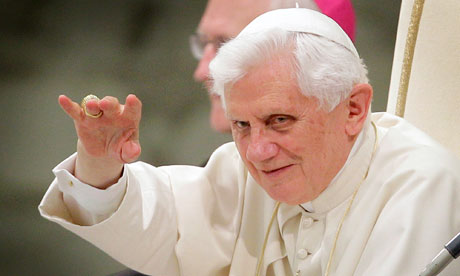
Britain was recently described by the Pope's aide Cardinal Walter Kasper as a "third-world country". An amusingly provocative statement, and a rather poor analogy for our country's famine of faith. He subsequently was dropped from the Pope's widely-publicised trip to the UK, 'for health-reasons'. Was he was referring to the fact that we are a secularly-governed society? I wonder if he would then consider India, arguably still considered 'third-world' (if we're using the outdated terminology) the same way?
What I find interesting is the way Cardinal Kasper phrased his poorly-considered aspersion on Britain. The way he so directly compared the value of faith to material wealth.
In the age and culture of unbelief that we find ourselves occupying, how else can we comprehensively descibe an intangiable thing's worth but to compare it with something monetary or material?
Last year, I read American Gods by Neil Gaiman. You've got to read it, it's flipping brilliant.

We follow the protagonist known only as 'Shadow', who has been released from prison to find that his wife has died in a car-accident. Whilst sucking his best friend's cock. Left with nothing, when he's offered a job by a mysterious dude known as Mr. Wednesday he takes it.
I can't be bothered to write a full plot summary, so SPOILER ALERT! Here is the jist of it:
Mr. Wednesday is Odin. And Odin is preparing for war. Old gods vs. new. The old gods are all that you could possibly imagine, from the Egyptian sun-god Ra to the Caribbean trickster Ananse. They have arrived and are sustained in the 'new land' by the fading trickles of belief that still comes from human minds. If someone- anyone- is still praying then the old gods exist, occupying both this world (where they live amongst us in disguise) and the dimension alongside it. Mythology overflowing into our familiar reality.
What makes American Gods truly fascinating however, is the New Gods. The god of television- with her perfect pin-stripe suit and dazzling smile, and Tech Boy- pale and covered in spots, but greedy and murderous. It goes on and on- from the god of Freeways to the Internet- set to become the New Gods' head-hancho.
It's his comparison of religious and corporate iconography that gets me. It's fucking genius. It's human recourse to turn to something beyond ourselves for comfort, distraction, purpose and meaning. It's just that nowadays we do it with Heat magazine instead.

Will Self says it pretty well in The Book of Dave. Set 500 years A.D. (After Dave). Dave is a schizophrenic cab driver in London whose wife buggers off with his child. We follow as he goes slowly mad, eventually creating his own religion based on the London cabbing 'Knowledge'. He has his religion engraved into a metal book and buries it at the end of his ex-wife's garden. Hundreds or thousands (we never know- but pigs have evloved) of years later, his book has been dug up and Davism adapted as the primary religion of the mostly submerged principality of 'Ing'. Everyone chats Mockney (the generic term for a hot meal is "curry" and for breakfast, "Starbucks") and Mummies and Daddies share custody of children, the 'Changeover' reflecting the ritualistic aspects of Dave Rudman's 21st century life.
A parody of modern religion and blind faith, Self "challenges the assumption of whether people should follow something just because it is written in an old book."
Personally, I am agnostic. Or a "fucking fence-sitter" if described by Professor Richard Dawkins.
Just a meandering little thought. Not really sure where this one is going.
Wells Blog
Duis mollis, est non commodo luctus, nisi erat porttitor ligula, eget lacinia odio sem nec elit. Maecenas faucibus mollis interdum. Nulla vitae elit libero, a pharetra augue.


Commodo cursus magna, vel scelerisque nisl consectetur et. Donec id elit non mi porta gravida at eget metus.